
For a place I hadn’t planned on visiting, Ecuador turned out to be terrific. I loved it. The scenery rivals the stuff you find in Peru and Colombia, the people are wonderful, the food is excellent, and the colonial towns are charming and comfortable. The country packs an enormous amount into a small place.
I spent only 10 days there, just using the country as a handy transit point to Peru, but came away wondering when I’ll be able to get back for a longer look. I’d expected to like it—most people do—but after a few days I began wondering whether I should delay my trip to Peru and spend longer in Ecuador. As it turned out I really loved Peru and spent more time there than I’d planned, so all’s well that ends well, but Ecuador stayed on my mind. I left a lot on the table, but in return I now have an excellent excuse to go back to South America (not that I needed one…).
I started my South America trip in Colombia, picking up where I left off when the pandemic hit in the spring of 2020, forcing me to leave in a hurry. I had unfinished business there. From Colombia I planned to fly to Lima, Peru, but after a little research I realized that starting in Lima would put me too far south to be able to visit many of the places I wanted to see in the north, so I came up with the idea of flying first to Ecuador, then traveling overland into the north of Peru.
Copa Airlines flies from Medellin, Colombia (where I was) to Guayaquil, Ecuador daily, and for cheap. What’s more, Copa Airlines offers a free “Panama Stopover”, which gave me the chance to spend an interesting three days exploring Panama City on the way. It seemed like a good solution. I planned to just hot-foot it across Ecuador, but in the process discovered a terrific country worthy of a lot more future travel time. Until I get there again, here’s what I found on my visit.
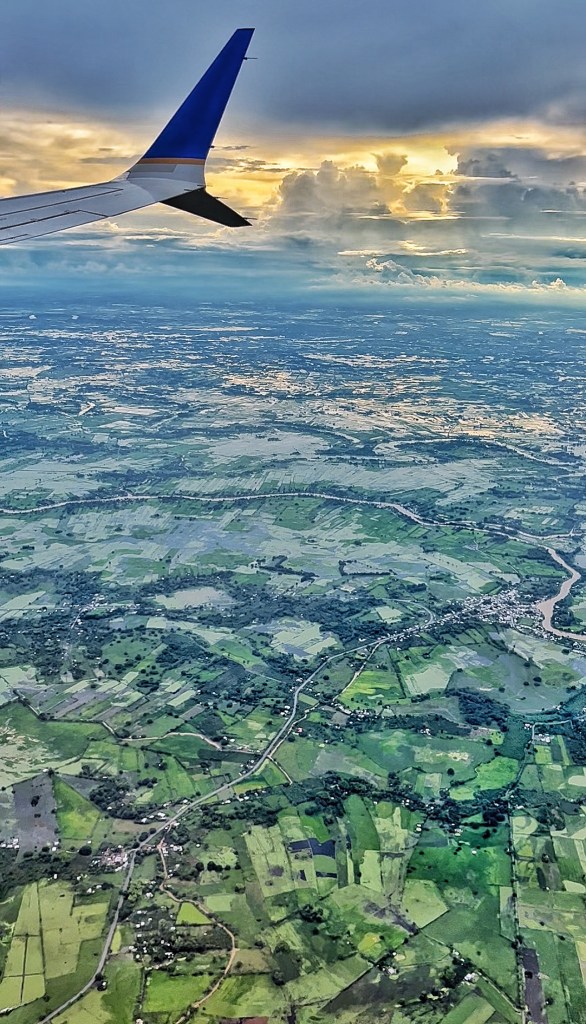
The view from the window, coming in to land in Guayaquil.
My Route
I flew into Guayaquil on March 15 and started from there. It doesn’t take a lot of fuss and bother to follow my route through Ecuador. I was there to go to Peru, as I mentioned, so there weren’t a lot of route options. Actually that’s not entirely true: there are three official border crossings between Ecuador and Peru. Macara is the main border post, and by far the busiest and most straightforward, but it’s for sissies; I wanted to cross at the smallest, quietest and most out of the way one of the three, known as “La Balsa” (or “La Balza”), which gave me just one option. Using Guayaquil as my entry point I went to Cuenca, then Loja, down the bumpy highway to Villacabamba, and finally on to Zumba where it’s just a short hop to the border.
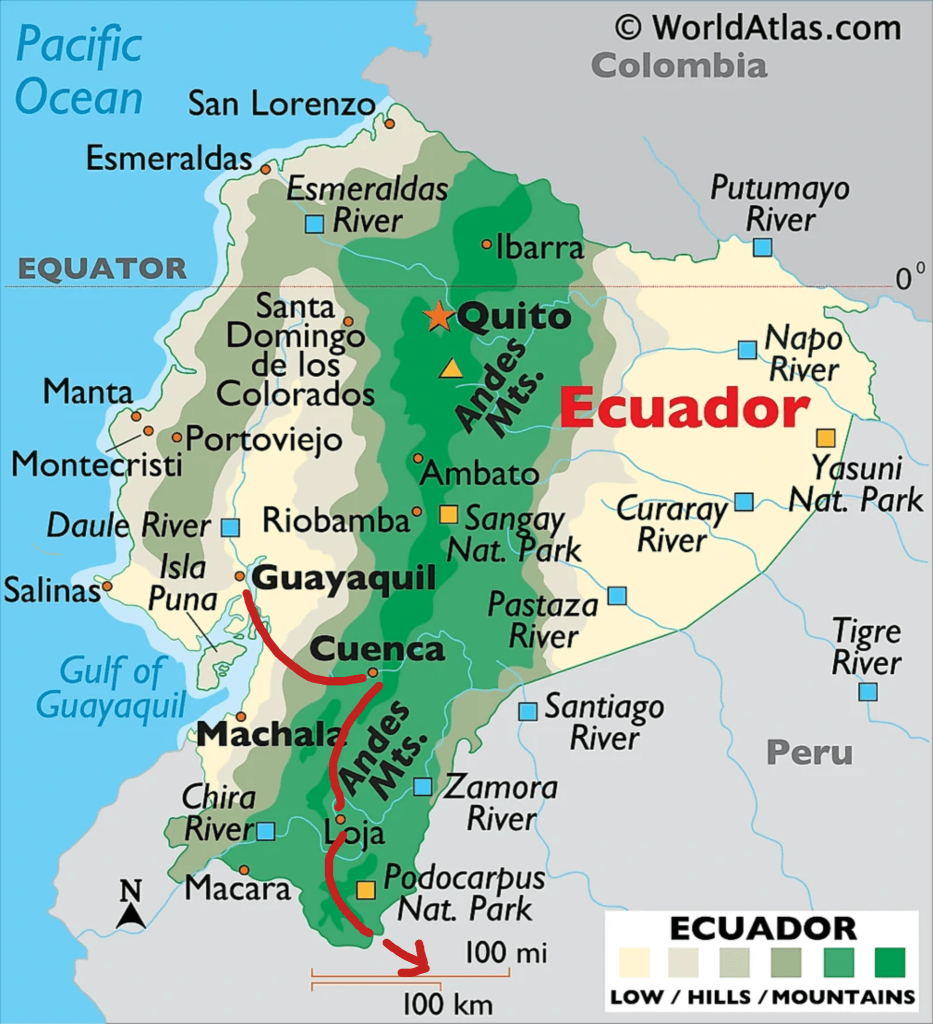
My route through Ecuador: Guayaquil, Cuenca, Loja, Villacabamba, and Zumba, then into Peru.
Guayaquil is not likely to make anyone’s Top Ten list. It has some sort of charm, here and there, and I didn’t have any problems, but overall it’s a fairly unattractive city, and is known as a dangerous place. Most tourists use the city as a starting point for a cruise, or a visit to the Galapagos Islands, so it’s not really set up as a traveler’s hub. Many areas of the city, including mostly all of the downtown financial and commercial zones, have a bad reputation when it comes to crime (mainly at night), which frightens the locals as well as potential tourists. That didn’t escape the attention of the folks who run the place, so they spent the last decade trying to tidy it up and improve security. A lot of money went into developing the riverfront, and there’s now a lively (and completely safe, even at night) promenade called Malecón 2000, full of strolling families, bars and restaurants, and vendors selling food, balloons and trinkets (malecón means pier in English). It’s a lively and pleasant place for an evening promenade. Guayaquil is very hot and humid (it’s more or less at sea level) so the malecón offers a nice breeze when the sun goes down.
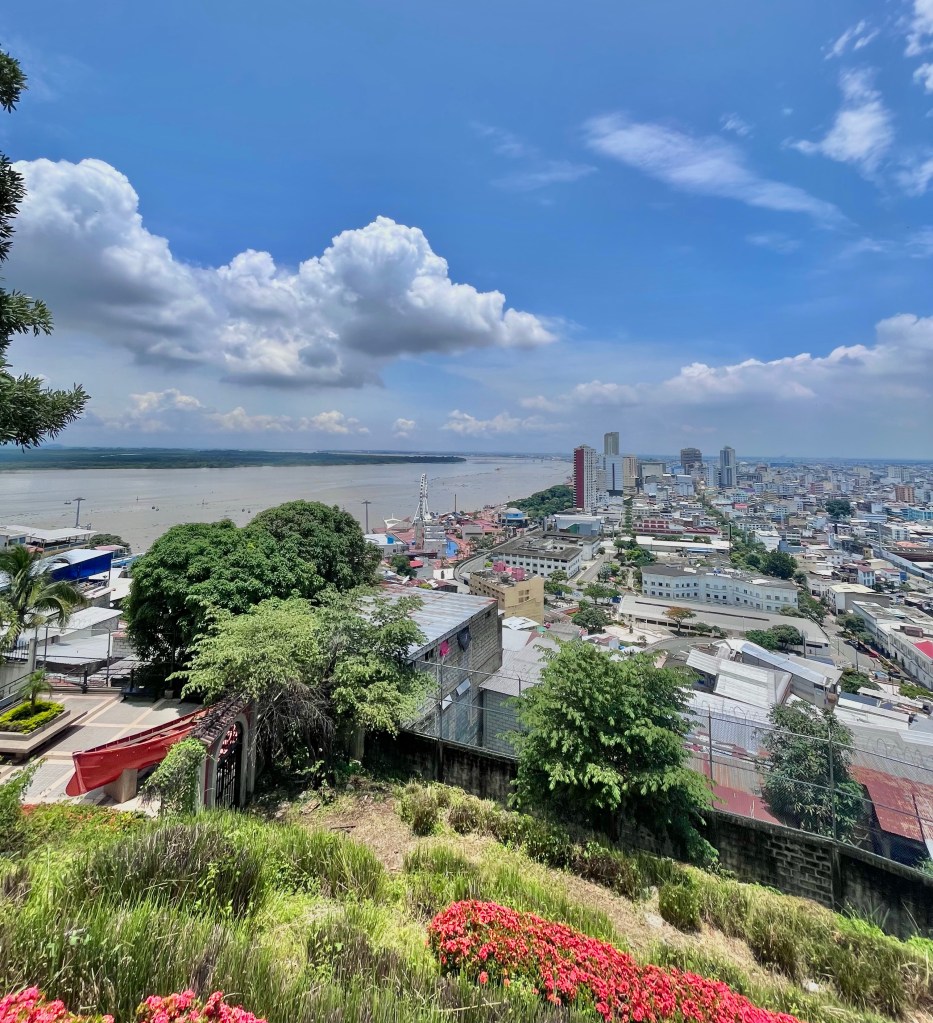
Central Guayaquil from atop the Santa Ana hill. You can see the wide Guayas River to the left.
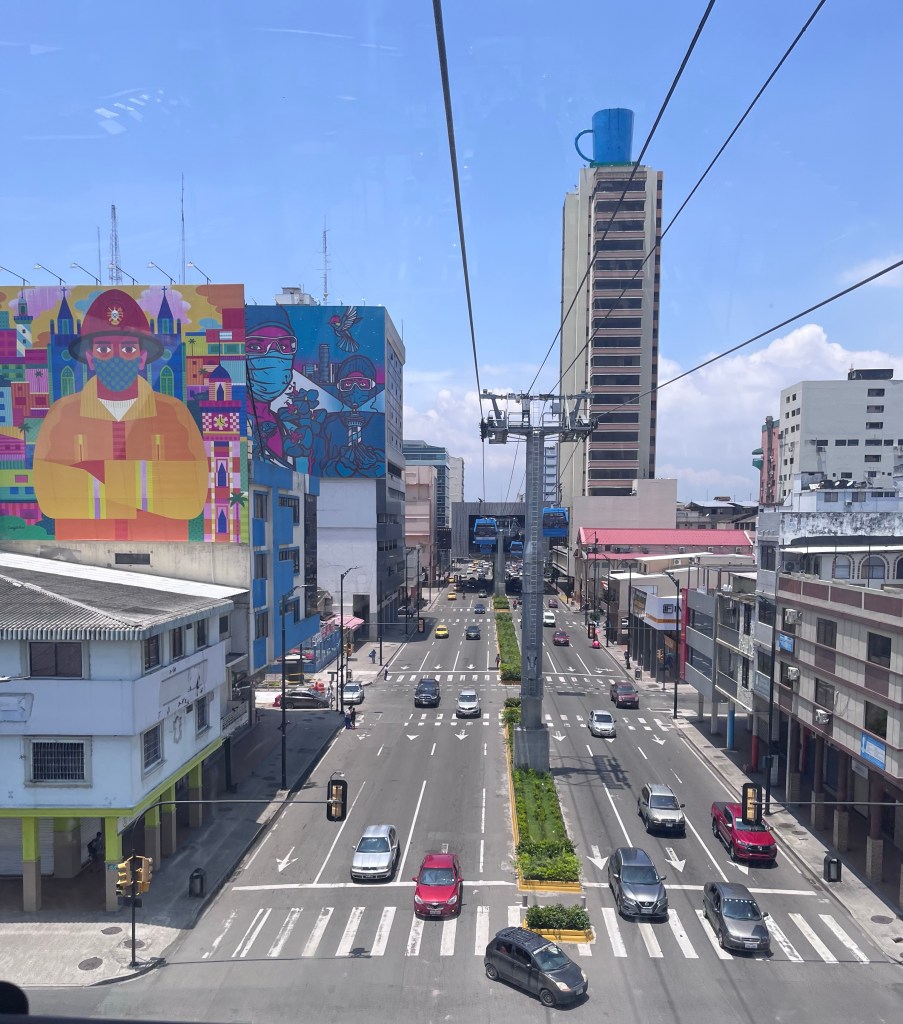
Downtown Guayaquil, with the cable car cutting through the center.
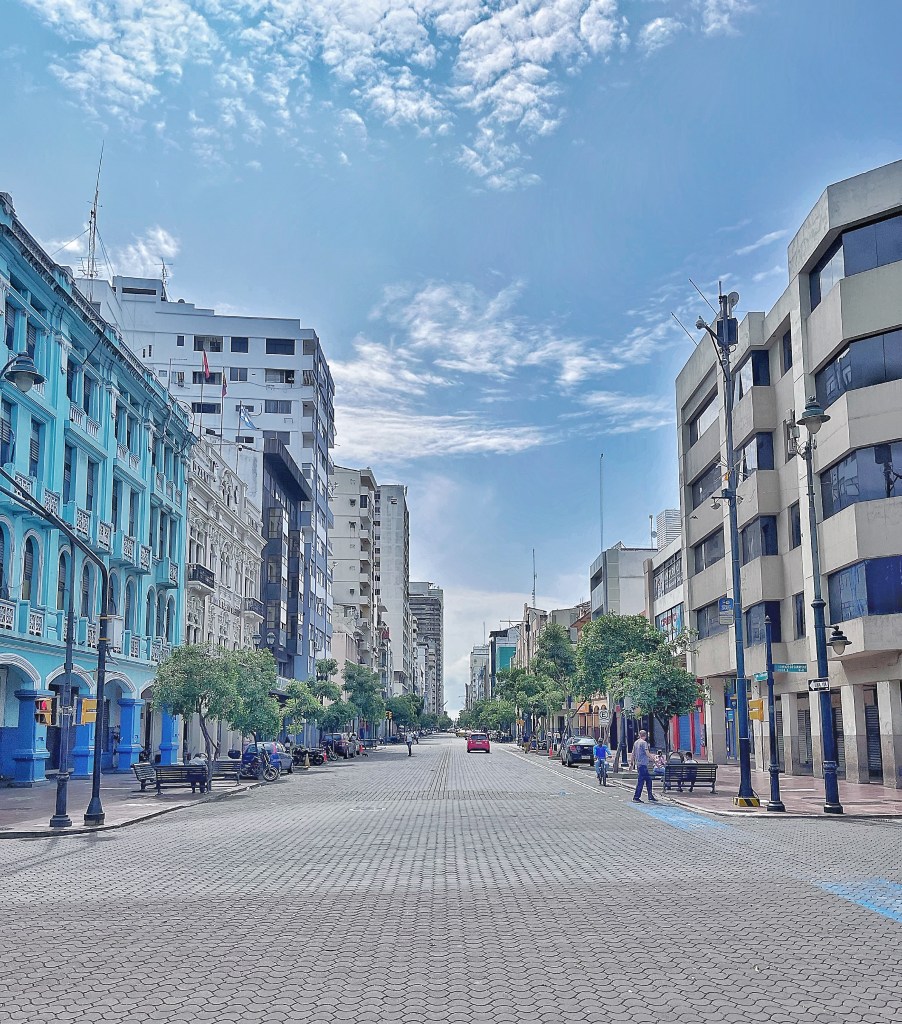
The clean and tidy streets of the commercial district in Guayaquil on a quiet Sunday morning.
Like many other South American cities there’s a cable car. The one in Guayaquil travels through downtown, then continues across the wide and fast moving Guayas River, very low, just above the water, which is really cool. It’s a great way to see Guayaquil, and you get a lovely cool breeze as you float above the city. Most of the downtown core is fairly clean, but there are a lot of abandoned buildings and closed shops, and a lot of people camping out on the streets or simply hanging around. The downtown area isn’t well lit away from the malecón, so I found the city a bit dodgy and unappealing. It didn’t make a good introduction to the country.
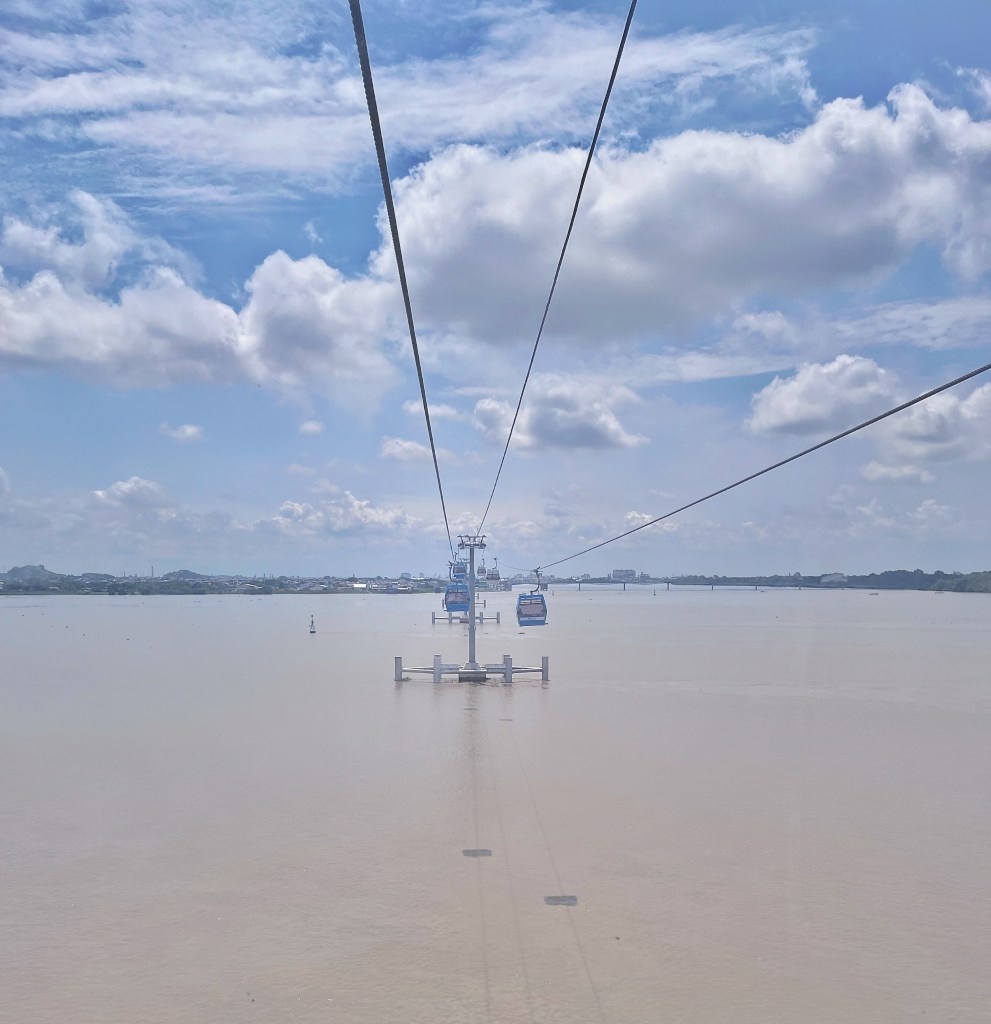
Riding the cable car across the Guayas River. The system is different from those in other Latin American countries where the cars usually go up and down the steep mountainsides rather than across flat rivers.
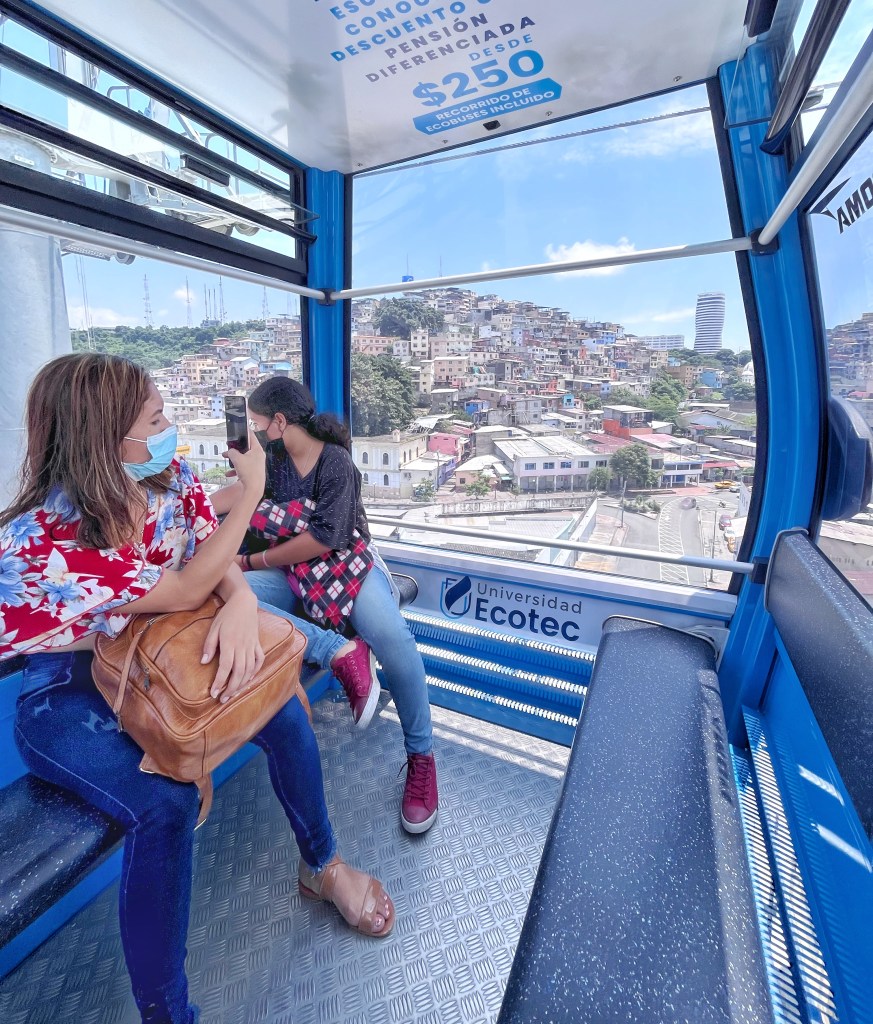
Sharing my cabin with two women from Quito who were in town as tourists.
Cuenca was my first stop once I hit the road, and turned out to be my favorite city, by far. A lot of travelers to Ecuador say the same thing, so I was expecting something attractive, and I definitely got it. Cuenca—officially called “Santa Ana de los Cuatro Ríos de Cuenca”— sits at 2,560 meters in Azuay province. It has a large and very well preserved colonial center (it’s a UNESCO World Heritage Site), terrific bustling markets, and a unique cityscape that looks something like a combination between Mexico, Austria, and Nepal.
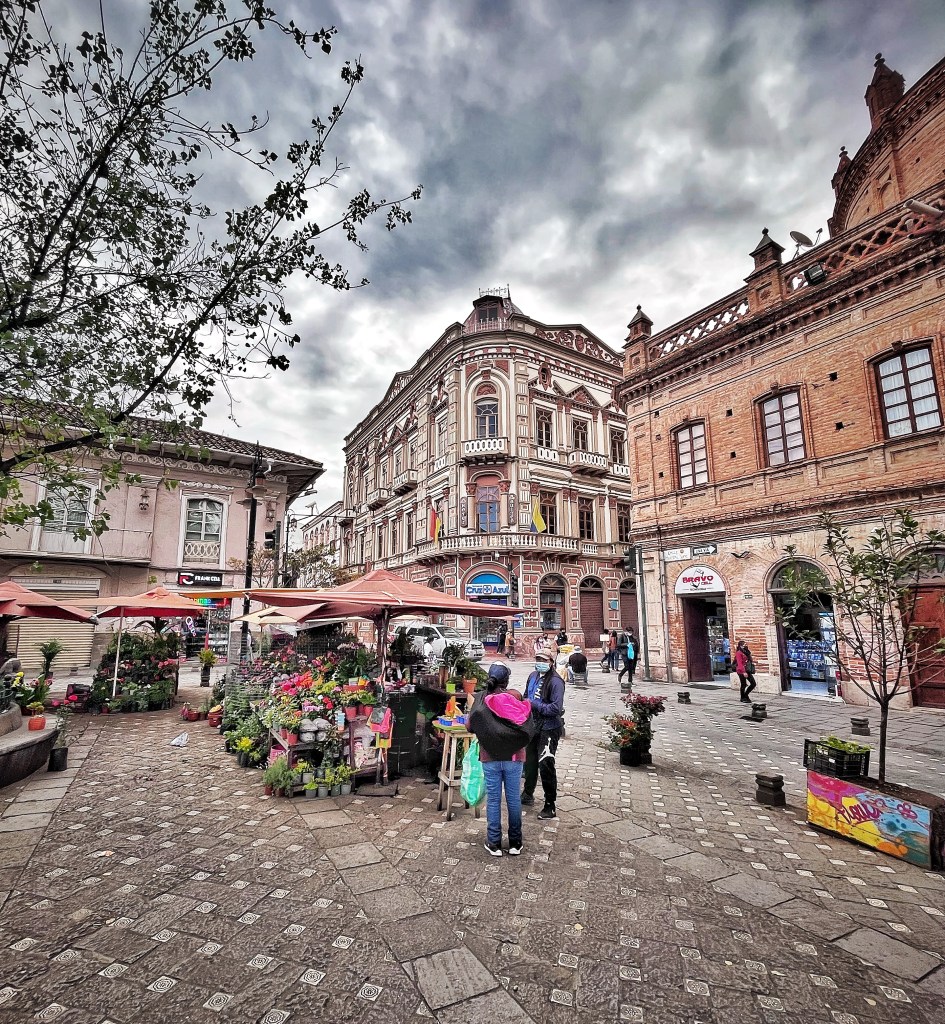
The pretty colonial streets of central Cuenca, my favorite place in Ecuador.
It’s hard to figure out exactly where one section finishes and another starts, so when you walk through town things change color and character quickly, and repeatedly. One minute you’re looking at a 16th century Spanish church in a flowery plaza, then you’re navigating a crowded street market choked with fruits, vegetables and household goods. Next you might find yourself in a leafy green park, then wandering down a residential street that looks in places like central Europe, complete with modern trams and smartly dressed residents.
I found an excellent hotel in Cuenca and enjoyed eating in the markets, drinking in the pubs, wandering through the historic streets and exploring the hilly, green countryside that surrounds it. There’s terrific walking in the nearby hills.
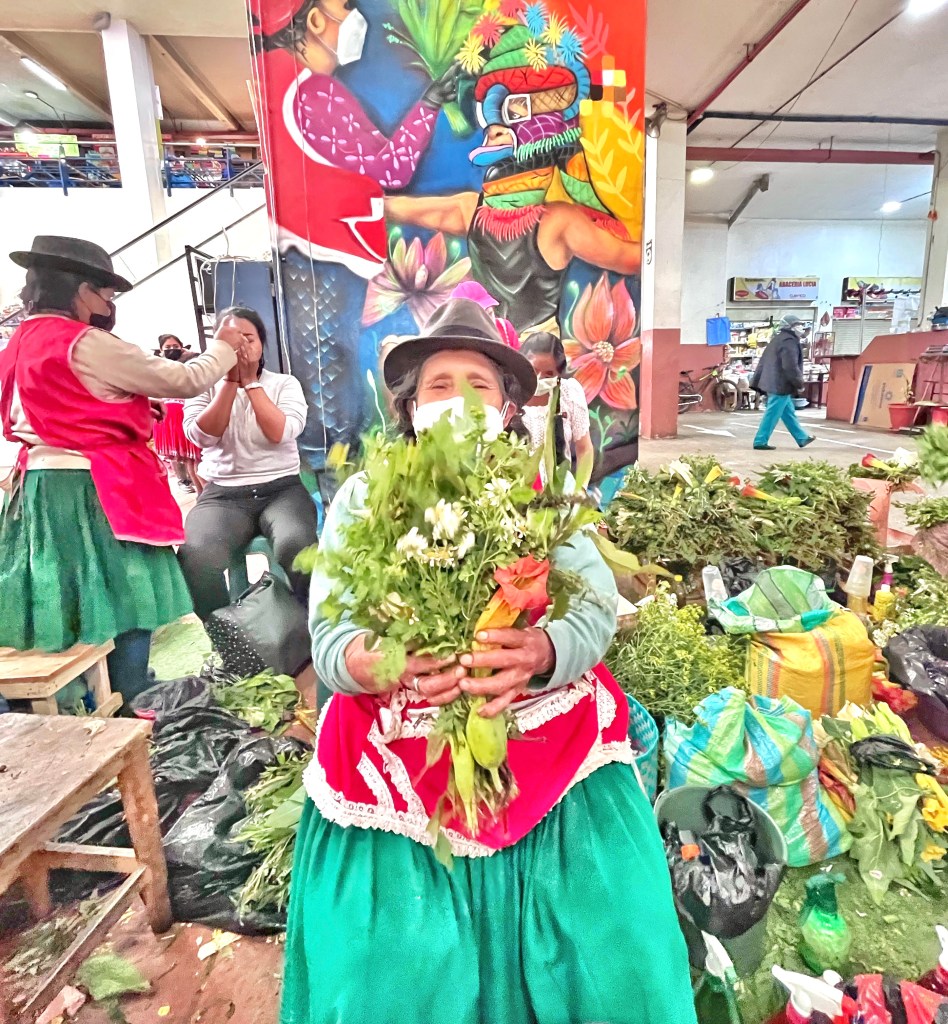
A “Limpia” (cleanser) in the market in Cuenca. For $3.00 you get rubbed, spat on, sprayed and anointed in an age-old cleaning ritual. I saw a few other foreigners, but mostly it was Ecuadorians being cleansed.
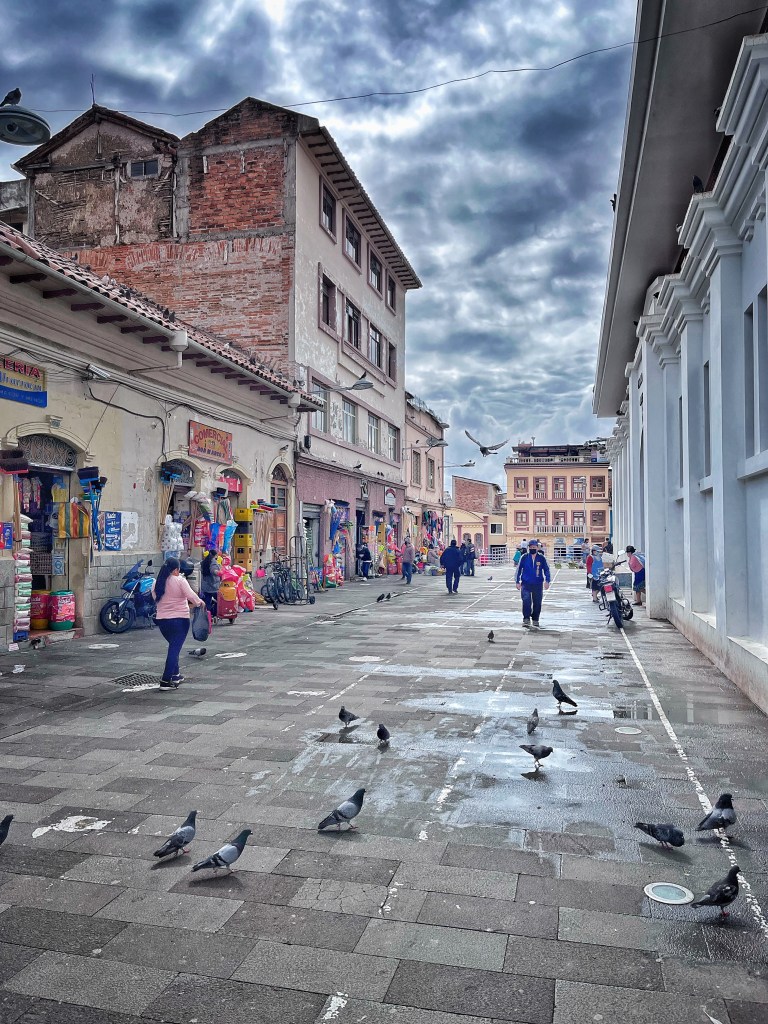
Cuenca.
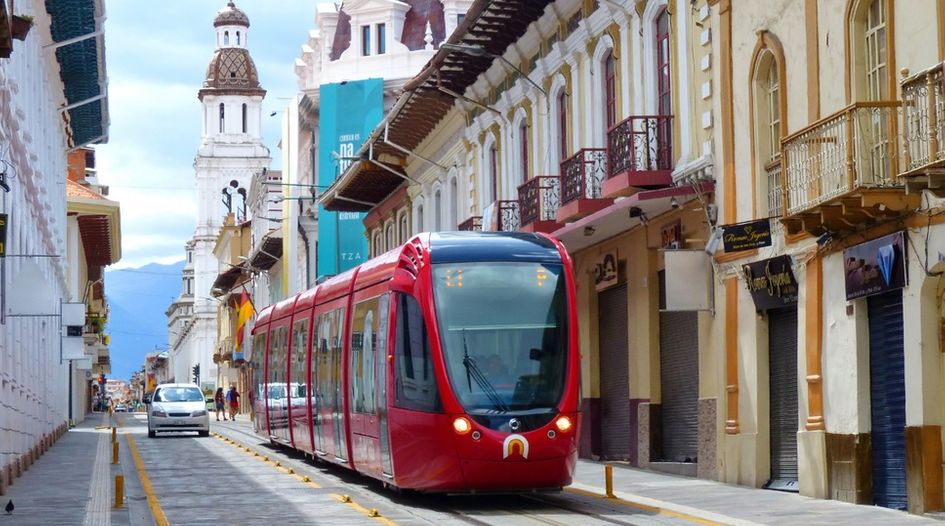
The tram in Cuenca was terrific – cheap, fast, and efficient.
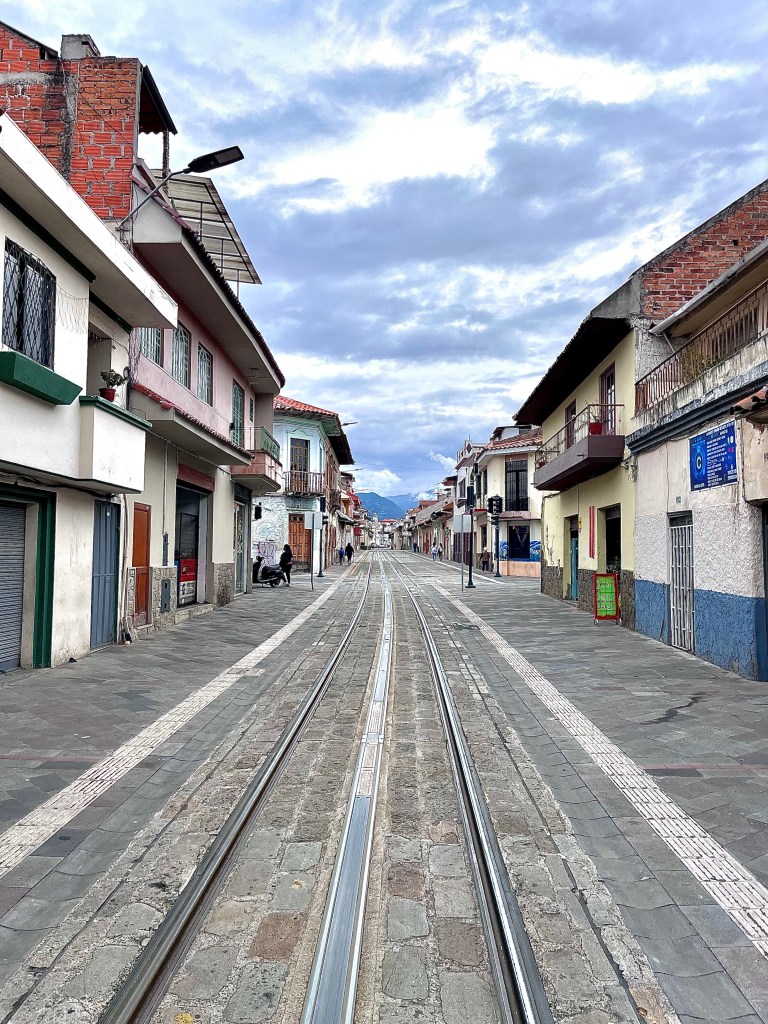
Cuenca has a cool tram system: the tracks are electrified, but only to the tram cars when they make contact, not pedestrians. The system comes from Alstom APS.
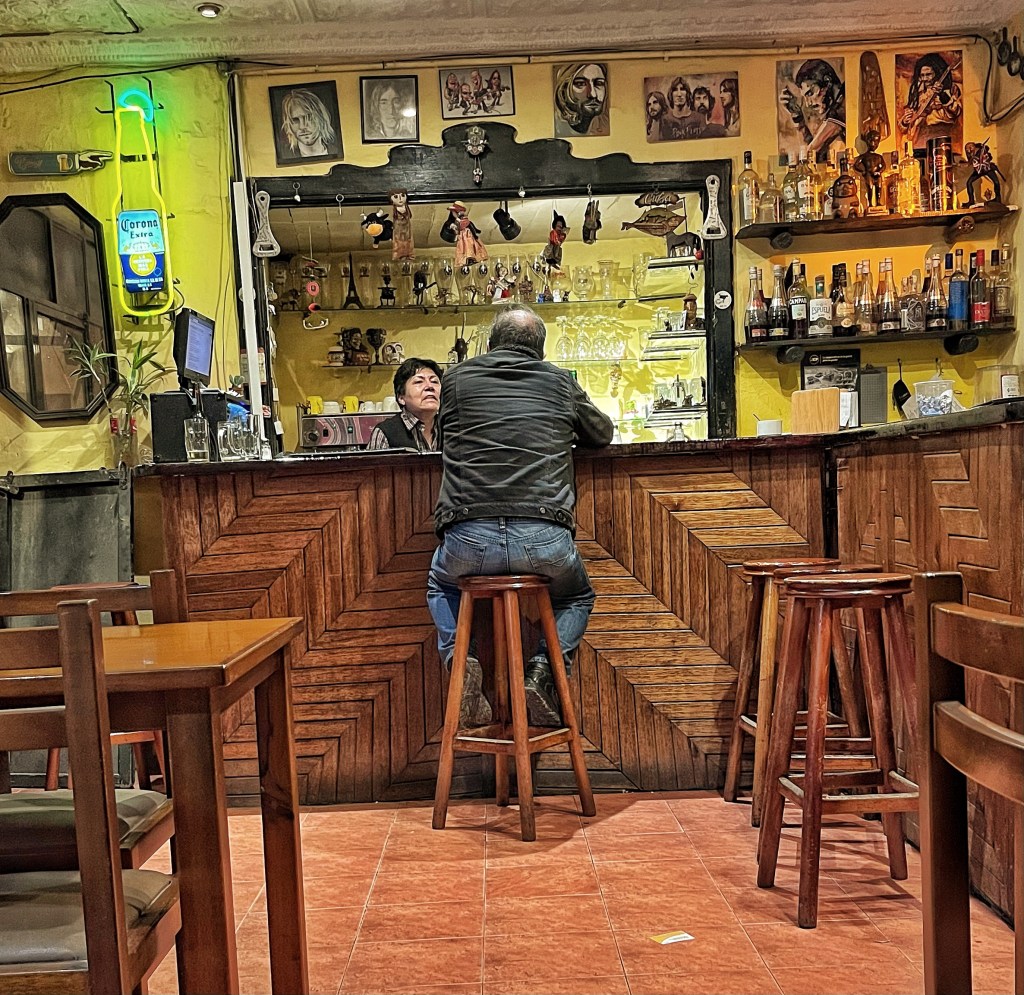
I never did find out the name of this bar in Cuenca, but it became my “local”. They played older rock music, softly, and had a nice selection of local and imported beers. Cuenca has a lot of good pubs.
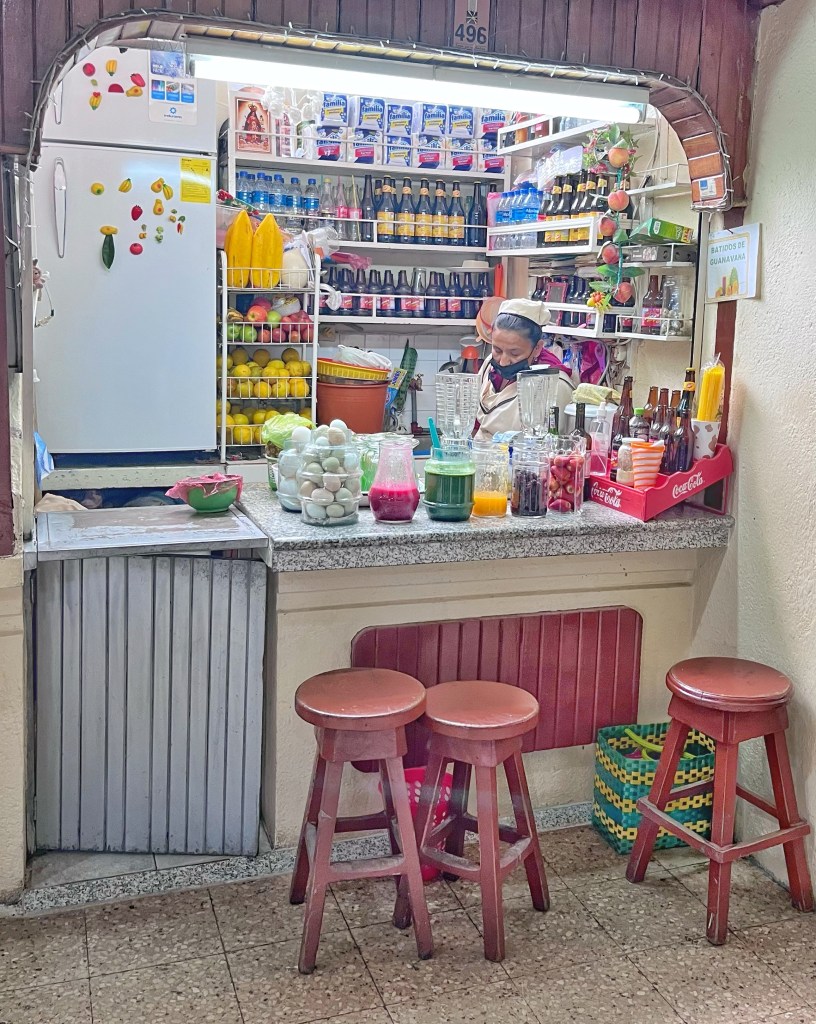
Drinks kiosk in the market in Cuenca. Fresh fruit and vegetable juices were cheap and tasty.
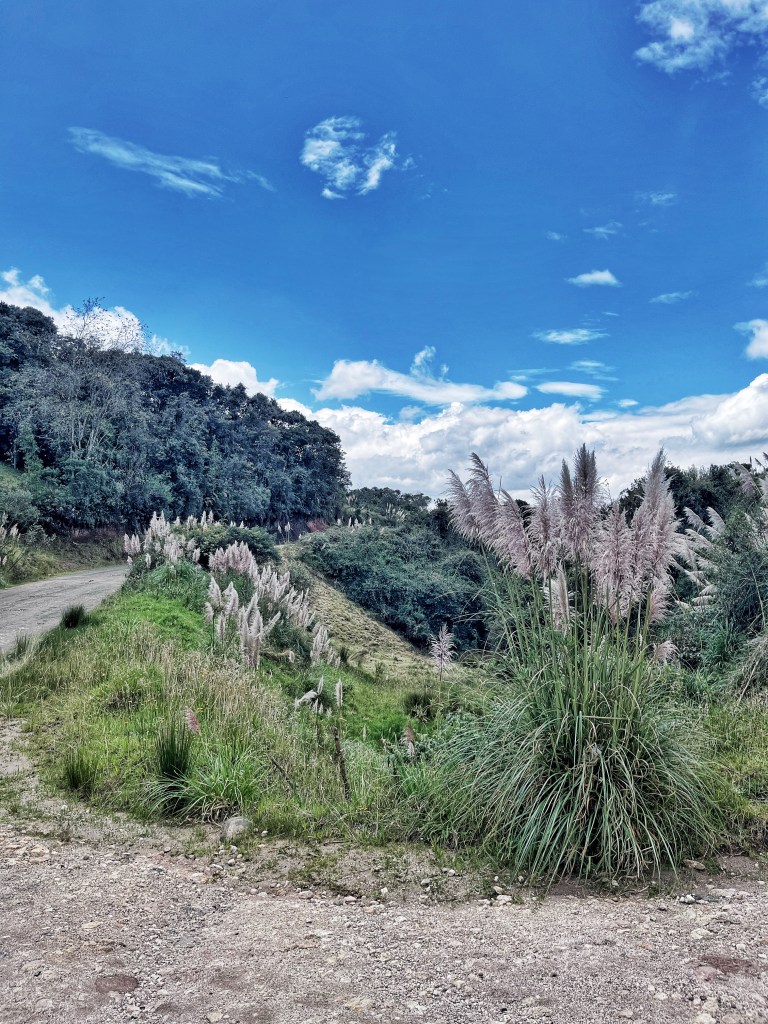
In the hills above Cuenca. There’s excellent walking in them thar hills.
Cuenca has about 400,000 people, not large but not small, so it has a big town feel and buzz but at the same time isn’t terribly hard to navigate. It’s a popular place for American and Canadian expats to call home, (frequently making the “Best Places to Retire” lists) though I didn’t really notice that many gringos when I was there. I got the idea most retirees live in the nearby countryside. Cuenca boasts a nice mix between modern and traditional, and fancy and rough, there’s an excellent selection of places to eat and drink, it’s safe, and the surrounding hills and country lanes are easily accessible. I really like Cuenca.
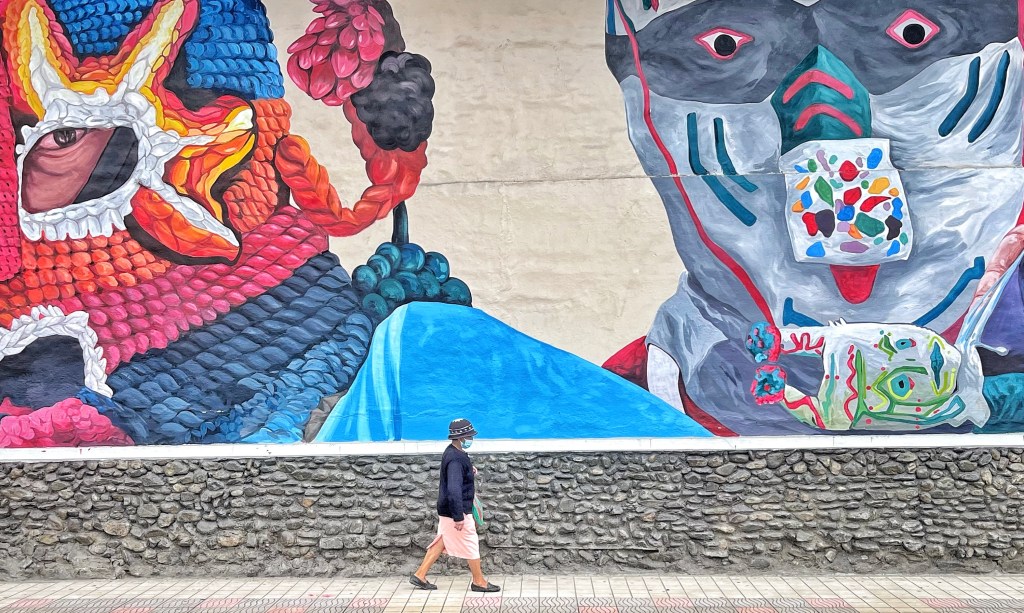
Next on to Loja. It’s much smaller than Cuenca, though still sizable at around 200,000 people. Loja sits at 2,060 meters, slightly lower than Cuenca, though the temperature and weather in both places was the same when I was there. Loja holds a rich tradition in the arts and is known as the “Music and Cultural Capital of Ecuador”. I spent a few hours at the Museo de la Música museum, housed in a still active music school where strains of piano, violin and woodwinds waft around the interesting photos and memorabilia.
The city is home to two major universities, so there are a lot of young people buzzing from place to place. The streets in the pretty colonial district are similar to Cuenca’s, though far less grand, and much more narrow. There are fewer large churches and plazas. Parts of the city looked a bit Bavarian, or Austrian, to me.
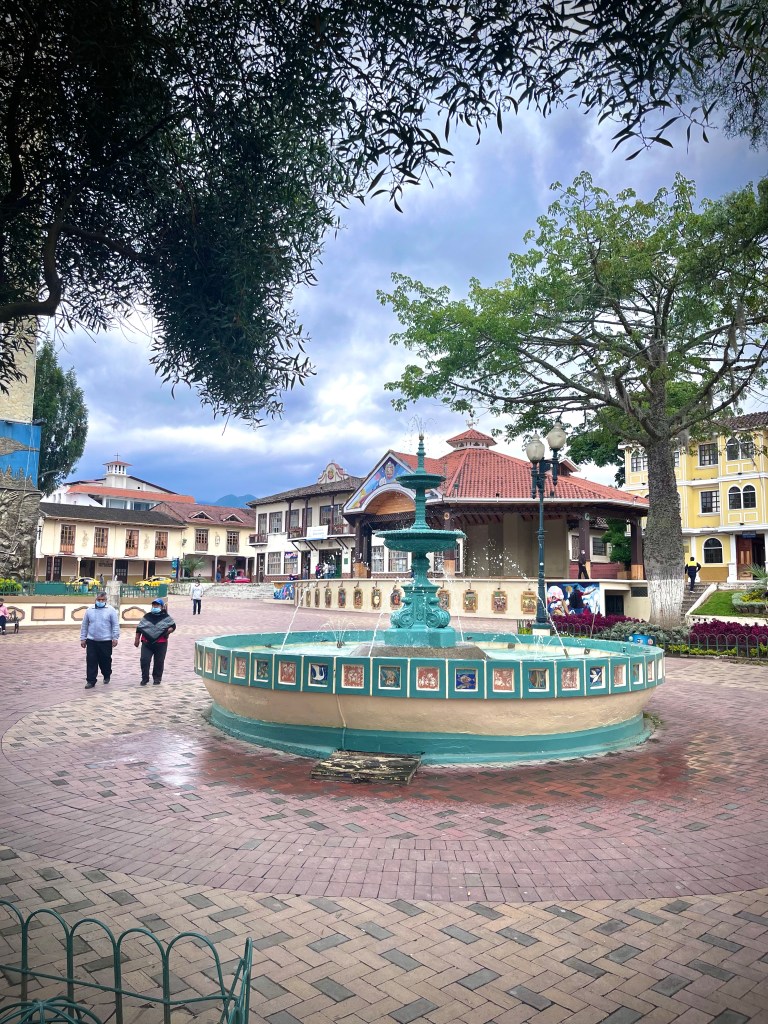
Plaza de San Sebastian, central Loja.
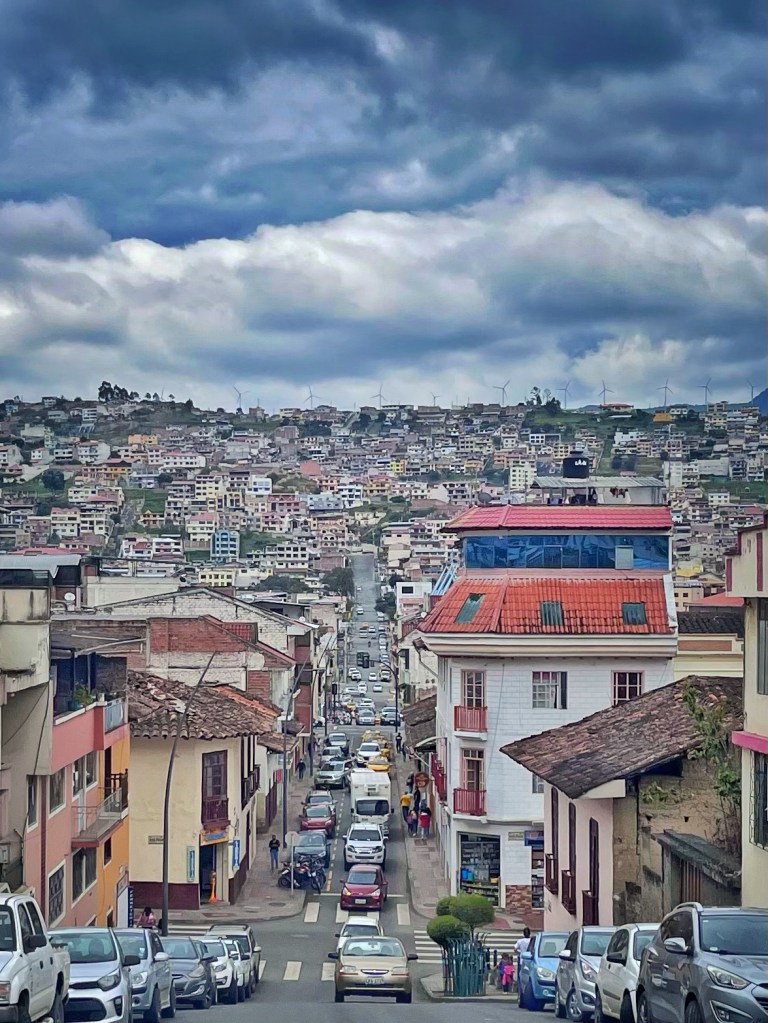
The new section of town, Loja.
The city of Loja has the distinction of being the first city in Ecuador to be wired for electric power, which is provided by a hydroelectric dam that was completed in the 1890s. Several people in town told me Loja was famous in Ecuador because of that (I never bothered to substantiate it). I found a great bar called “El Viejo Minero” (“The Old Miner”) where I joined a large and noisy group of locals watching Ecuador and Paraguay battle it out for a qualifying position in the upcoming World Cup (Ecuador lost the match but had already qualified, so no one seemed too bothered with the result, not even the Ecuador national team).
After two nights I traveled from Loja to Villacabamba by share-taxi and chatted with local Armando for the short 45 minute hop. He works for the school board in Loja province and was on his way back to Villacabamba where he lives with his wife and two kids. I bumped into all of them the next day in the street, Armando pleased and proud to introduce me to his family who all smiled and shook my hand.
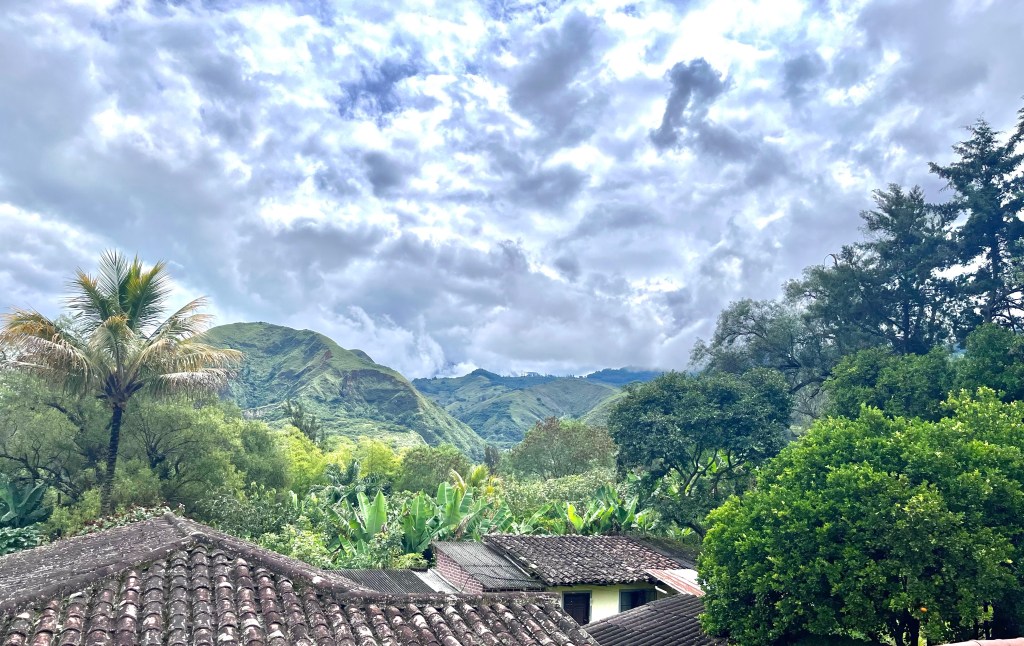
As seen from in the hills on a walk outside of Loja on a beautiful day.
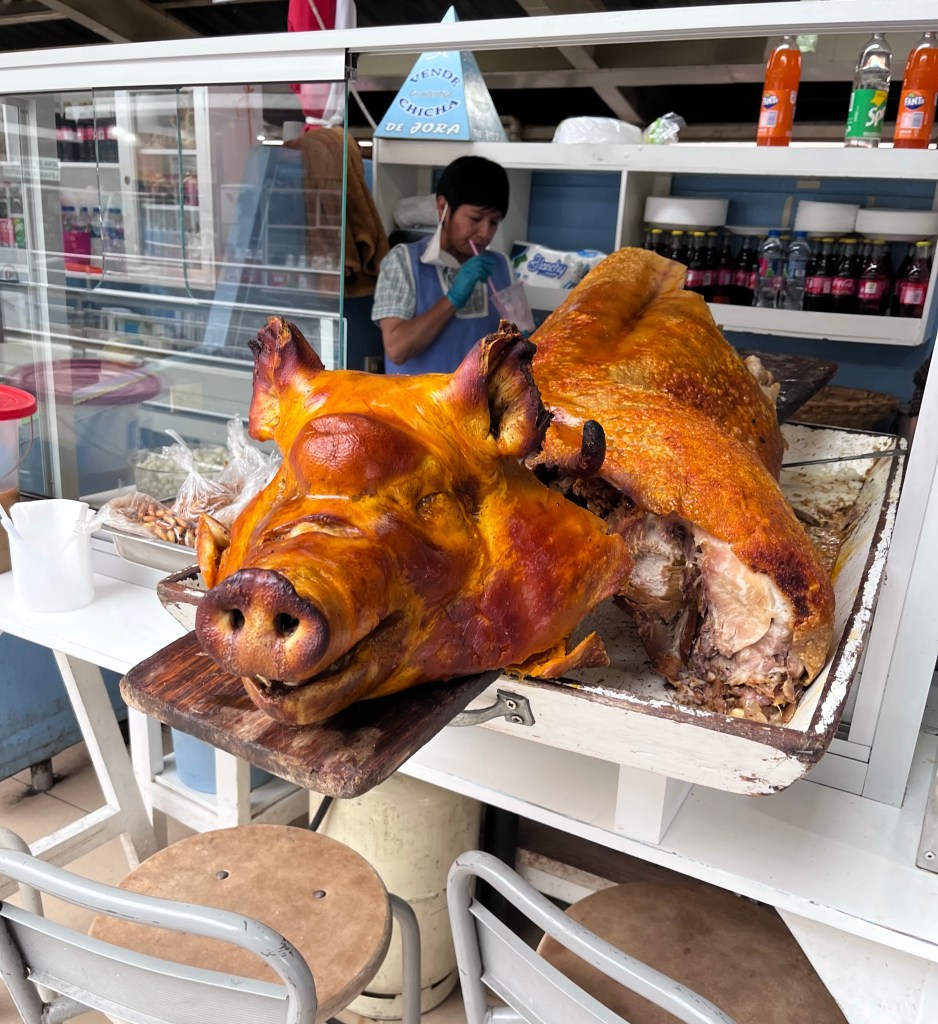
The vegetarian section of the Loja central market.
Villacabamba is set in beautiful green rolling hills and is extremely tranquil and pretty with lovely, friendly people. It’s a small place with only a little over 5,000 residents, but has some surprisingly good restaurants and cafes, mainly because there are so many foreign residents in the area, something that really surprised me. I’d never heard of the place, but there are a lot of Americans who retire in Villacabamba and run small businesses, many married to local men or women (there are some Germans and French, too, but mostly Americans).
The foreigners seem to be separated into two groups, the older, largely conservative group (quite a few Trump and “freedom” supporters), and the hippy group. The older conservatives looked older and conservative—largely white, with shiny clean teeth and sensible shoes and sun hats—and the hippy group definitely looked hippy-ish, with bare feet, baggy cotton clothes, and dreadlocks. It was odd, actually, and incongruous with the town’s rustic location in the middle of an out-of-the-way Ecuadorian valley, though to both groups’ credit they all seemed to speak Spanish, and were polite and inclusive. The town seemed peaceful and relaxed, so I guess they’re making it work.
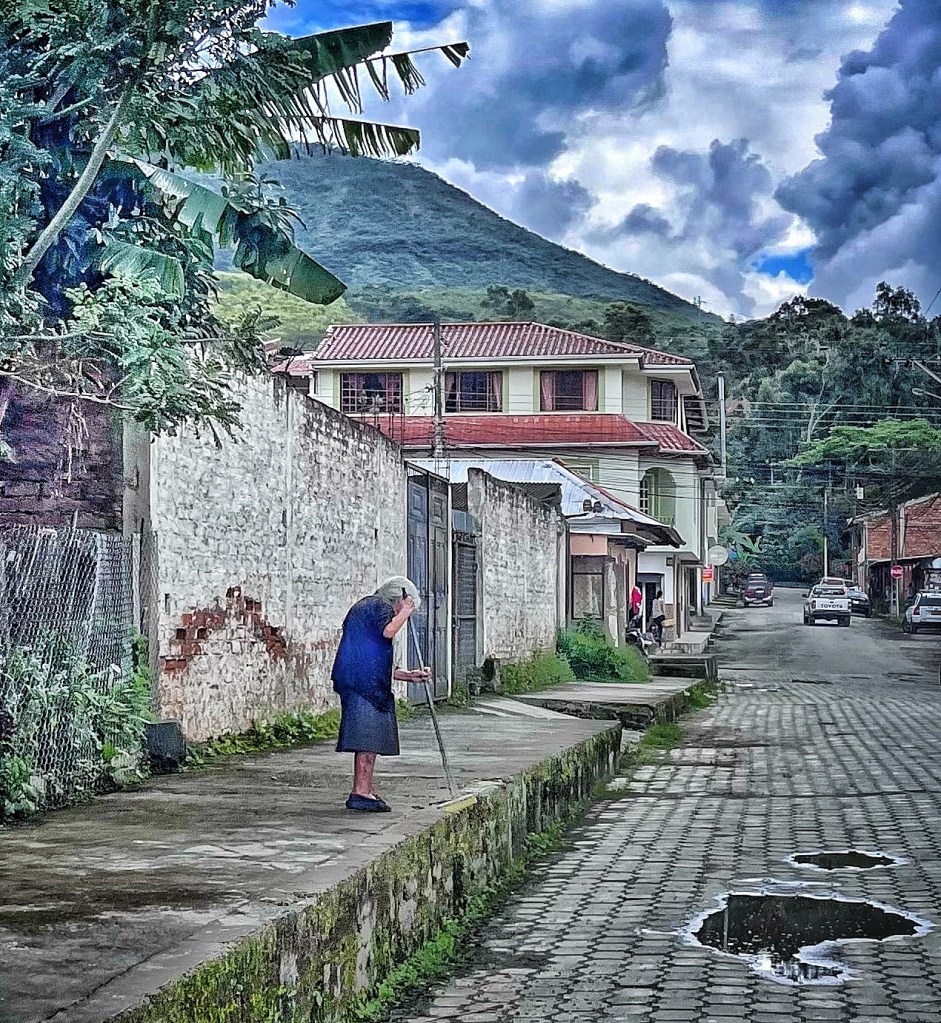
The quiet and cozy central core of Villacabamba.
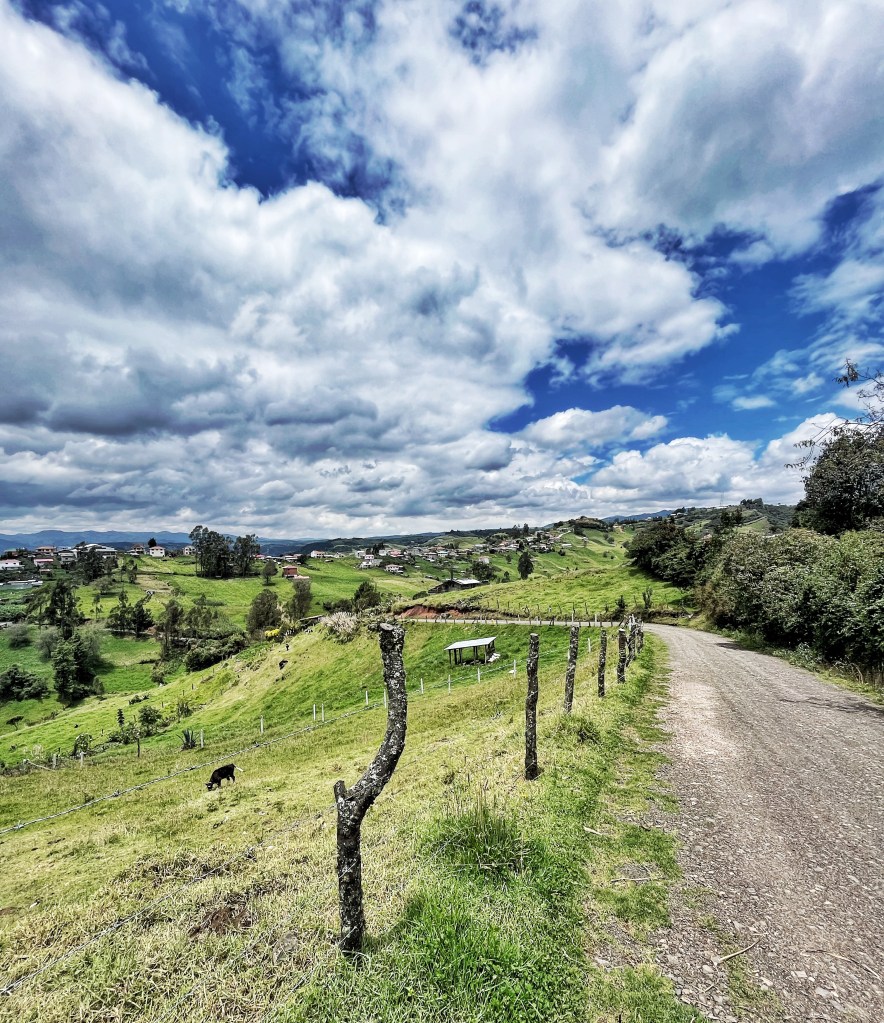
The hills and villages outside Villacabamba. The walking everywhere I went in Ecuador was outstanding.
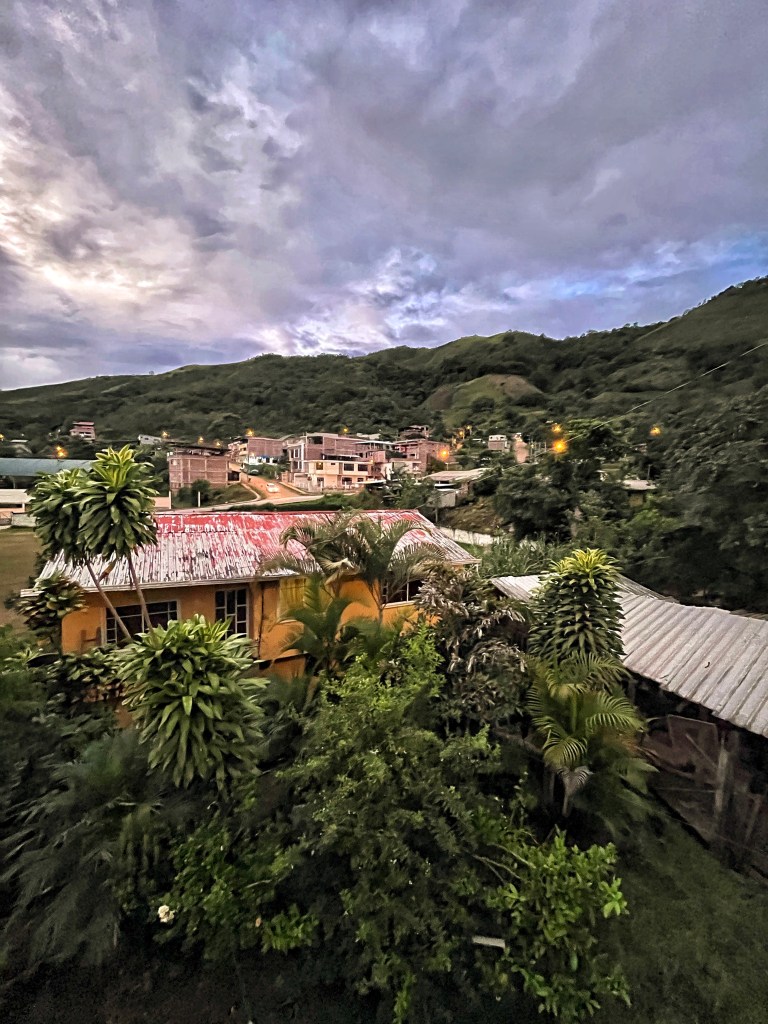
Dusk in Villacabamba.
I asked several locals why, of all places, Villacabamba attracts so many foreigners. It’s a popular destination, they explained, because it is widely believed that people there grow to a very old age. Often called the “Valley of Longevity”, locals say it’s not uncommon to see a person reach 100 years of age, and it is claimed that many have gotten to 120, even up to 135, which would make it an area with the oldest inhabitants in the world. I didn’t see anyone who looked that old, and didn’t bother to do any further research into the matter, but certainly people on the surface appeared healthy, and there were a lot of old people, so who knows.
I stayed in a rundown but clean guest house on the top of a hill just outside of town and really enjoyed wandering the valley and talking with the very chatty and friendly locals (happy, perhaps, because they’re so excited about living such a long time). I met a guy from Oregon named Jaden, who was on a longer South America trip, and enjoyed some English conversation and a few beers with him one evening at a bar owned by a man originally from South Carolina who’d hung an American flag on the wall and refused to be vaccinated.
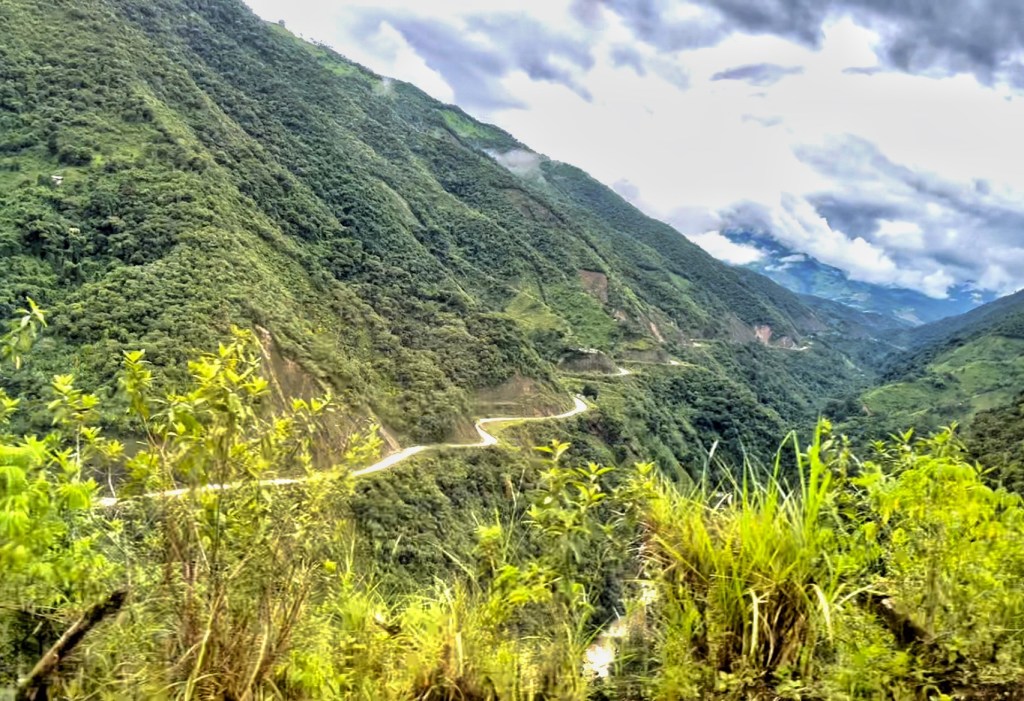
The road between Villacabamba and Zumba. Pretty, but terrifying.
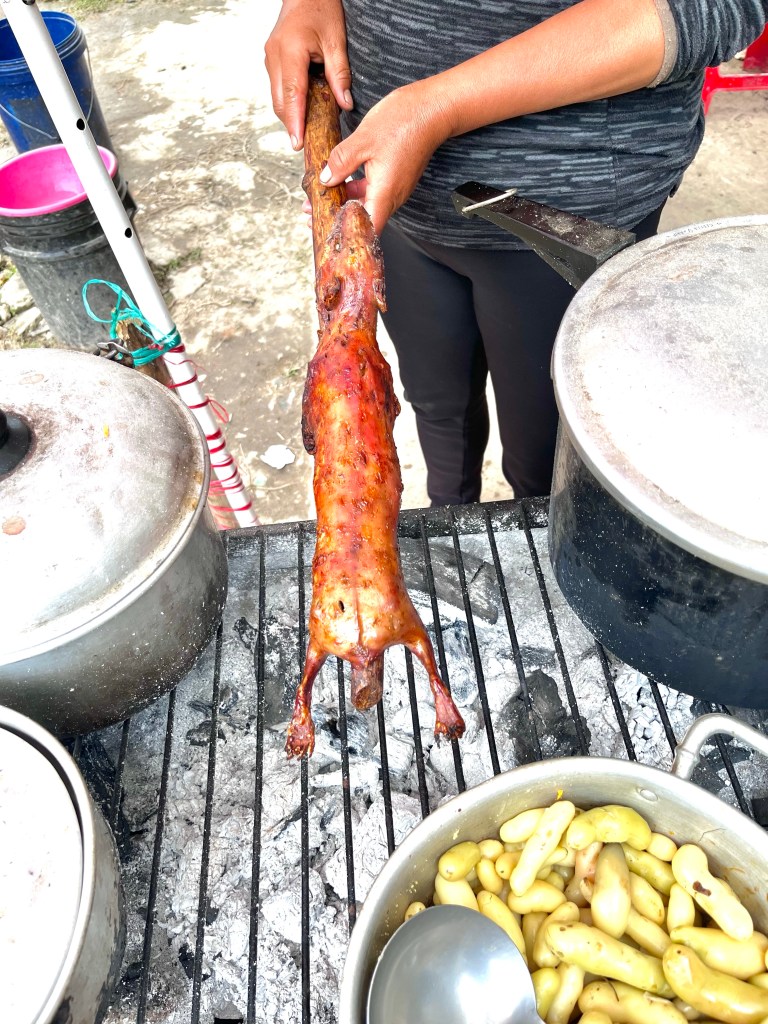
Fried Guinea Pig at a rest stop on the road between towns.
After Villacabamba I went south to Zumba, the last town of any size in Ecuador before the border. There are around 9,000 residents making it larger than Villacabamba, but it felt much smaller. It’s a very quiet, provincial place with not much going on as far as I could tell, though everyone was friendly and the town was tidy and well organized. It was a hair raising ride in a rickety bus getting there, over extremely twisty and rough roads with steep drops into the valleys below. Twice the bus had to stop and reverse on a corner to try again, the turn at first being too tight. One time the driver actually got out and walked to the other side of the bus to evaluate how far off the road the rear wheel might be permitted to travel in order to make the turn. It was an exhilarating journey, but scary, and I was very happy to get off when it was over.
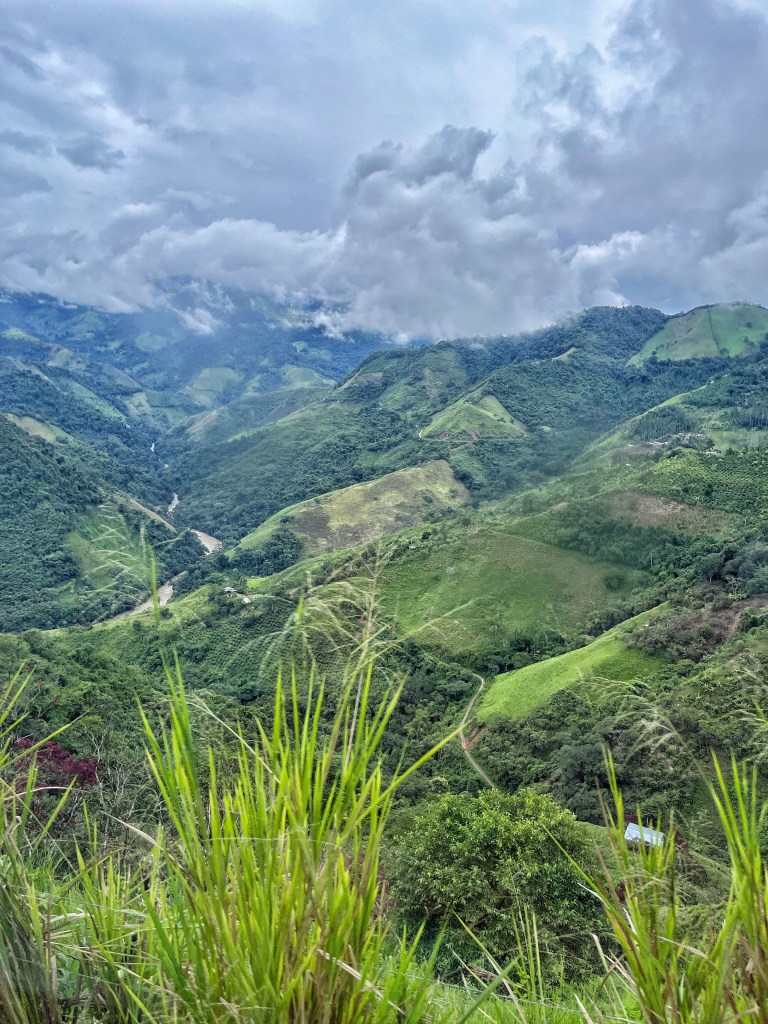
A shot taken from my window on the bus on the way to Zumba.
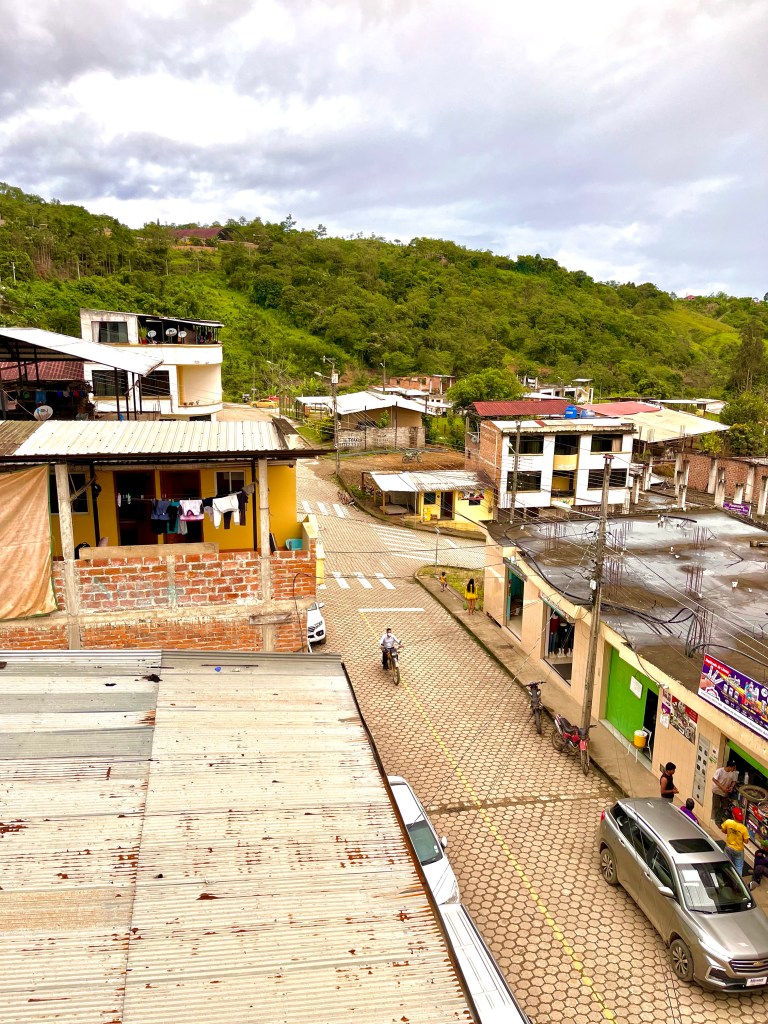
The little town of Zumba, last stop on the way to Peru. This photo was taken from my hotel window.
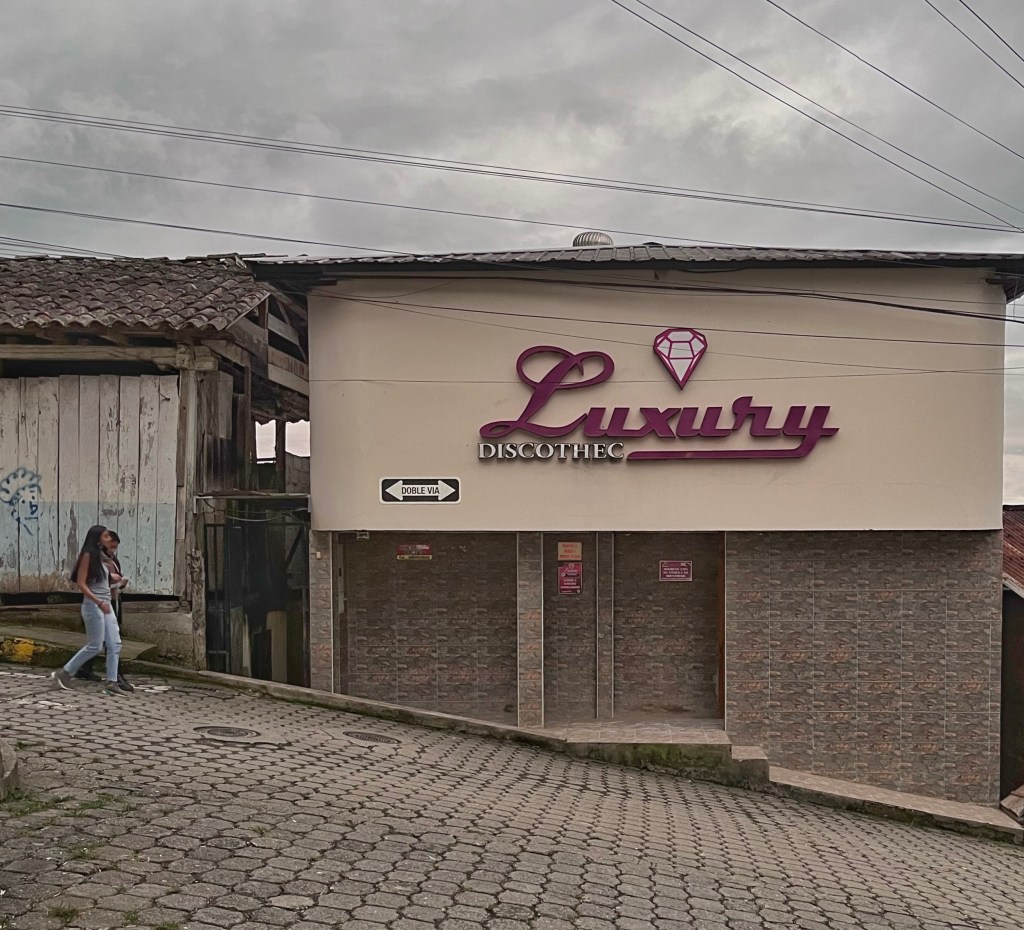
The Luxury Discotheque in Zumba, sadly closed when I was in town.
The road from Loja is quite new. It used to go only as far as the town of Palanda, some 50 km north, but was expanded in 1965 when a plane, flying in poor weather over treacherous terrain, crashed on the way to Zumba killing everyone on board, pressing home the need for a road. Personally I can’t see how that death-road I traveled over could possibly be any safer than flying, but I survived, and there haven’t been any more plane crashes since, so I guess it’s been a better solution.
To get to La Balza border crossing I took a ranchero the next morning (after a very comfy stay in the Hotel Calem, surprisingly one of the best hotels I stayed at in South America, and a bargain at US$15 per night). I’d never come across a ranchero before. It’s a large, open-sided bus with big tires that’s used to transport people over rough roads. The seating area is covered but, instead of chairs like you find on a normal bus, everyone instead gets bench seats welded to the chassis. The best thing about it is that it goes slowly, with none of the mad careening across sketchy mountain roads that I experienced getting to Zumba.
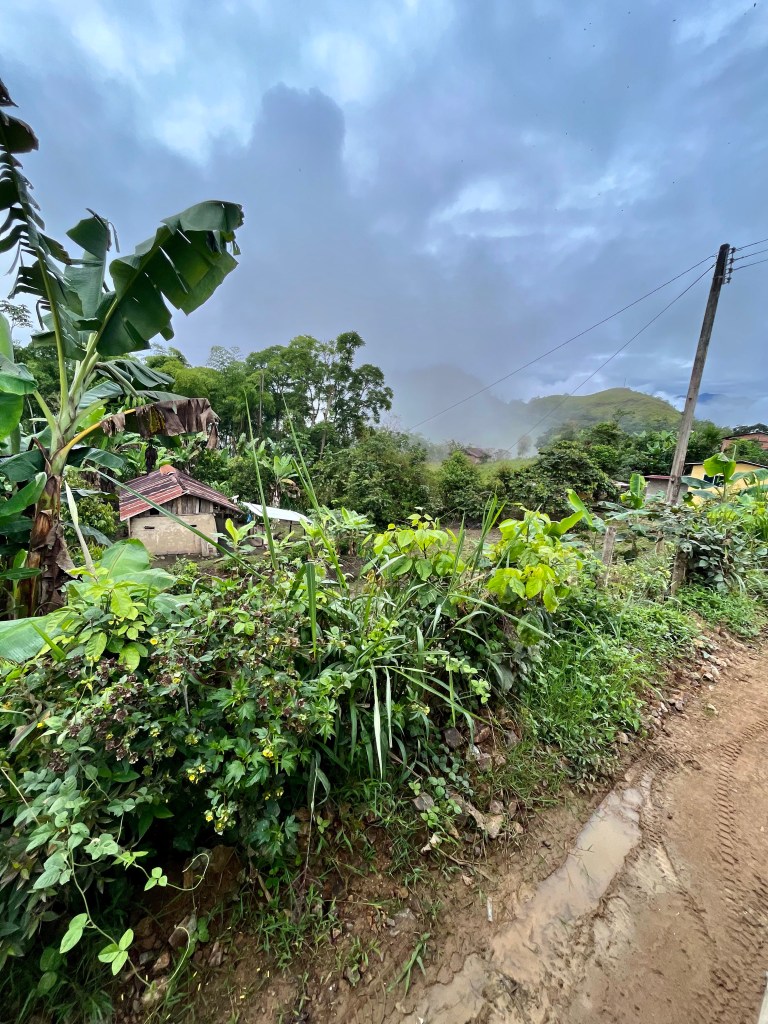
One of the many little farmsteads we passed on the way to the border.
I asked the driver why rancheros are open sided, thinking it might have something to do with the terrain, or the mechanics, but he told me it was simply cheaper putting in wooden bench seats than an actual bus body. Fair enough. It was a fantastic trip, though quite cool in the early morning air when we got going. It took about 90 minutes to the border where I walked across into Peru after a wonderful 10 days in Ecuador (see my blog post on Peru, here).
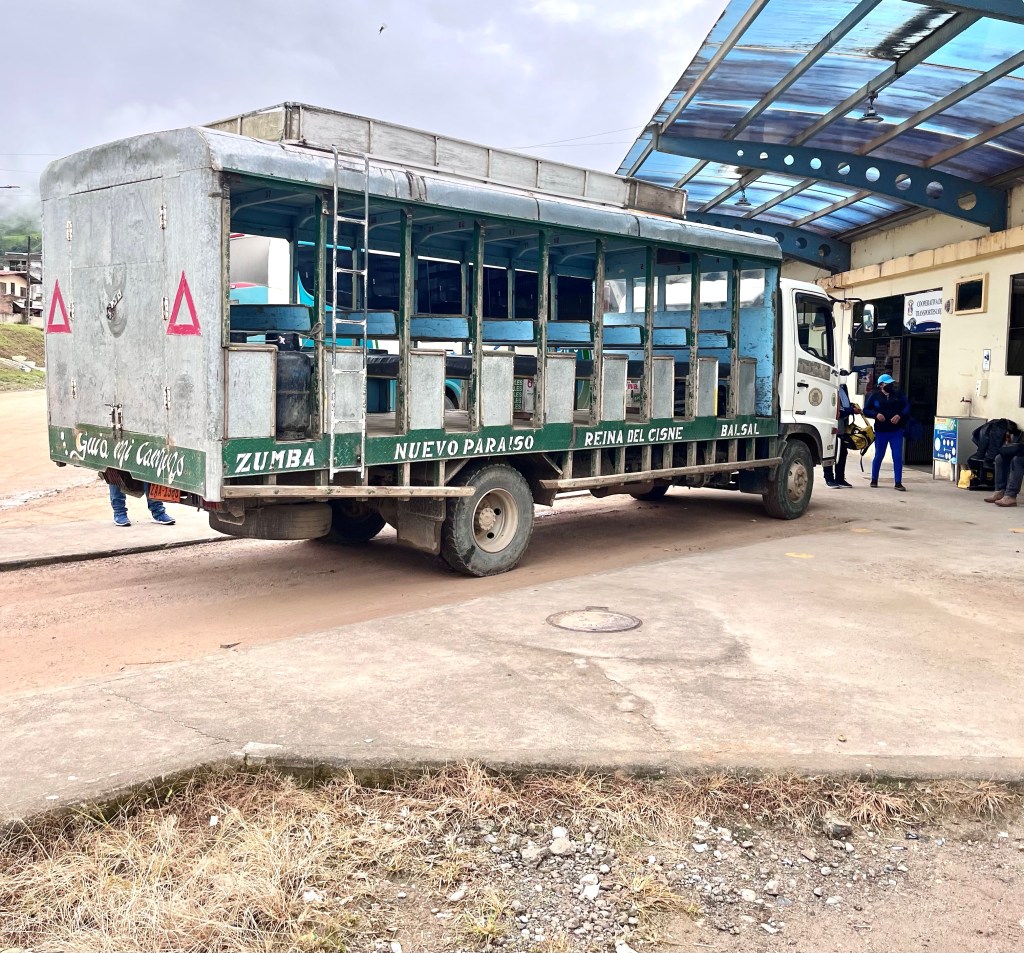
The ranchero we took from Zumba to the border. Fun and exciting!
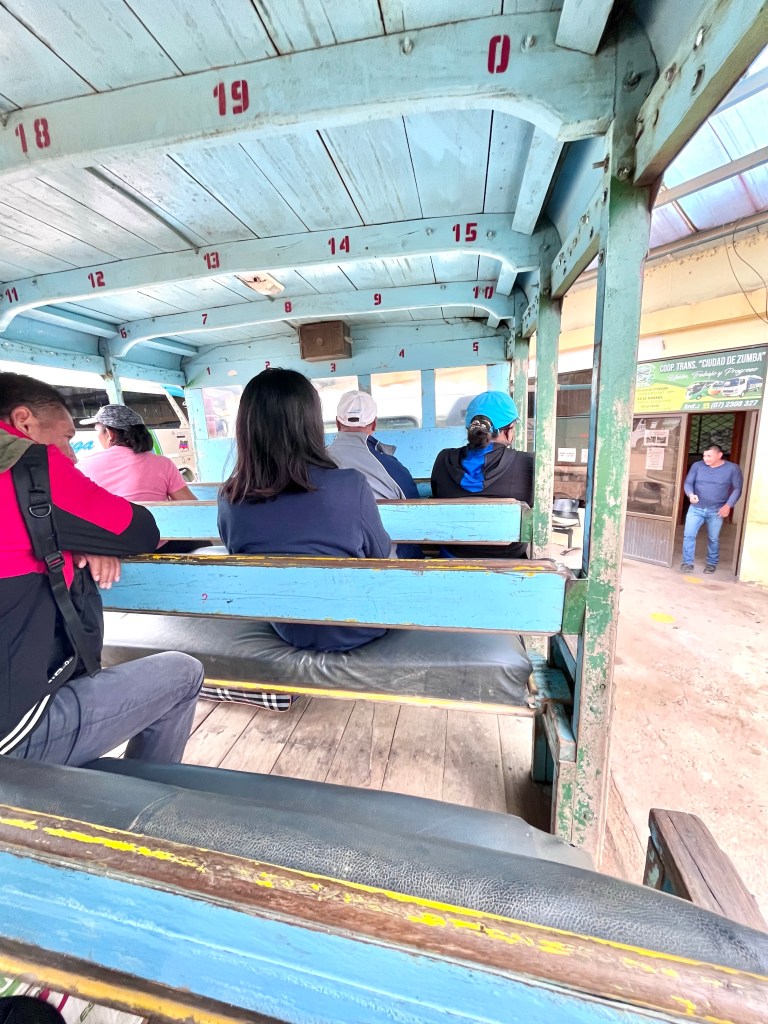
Ready for ranchero action.
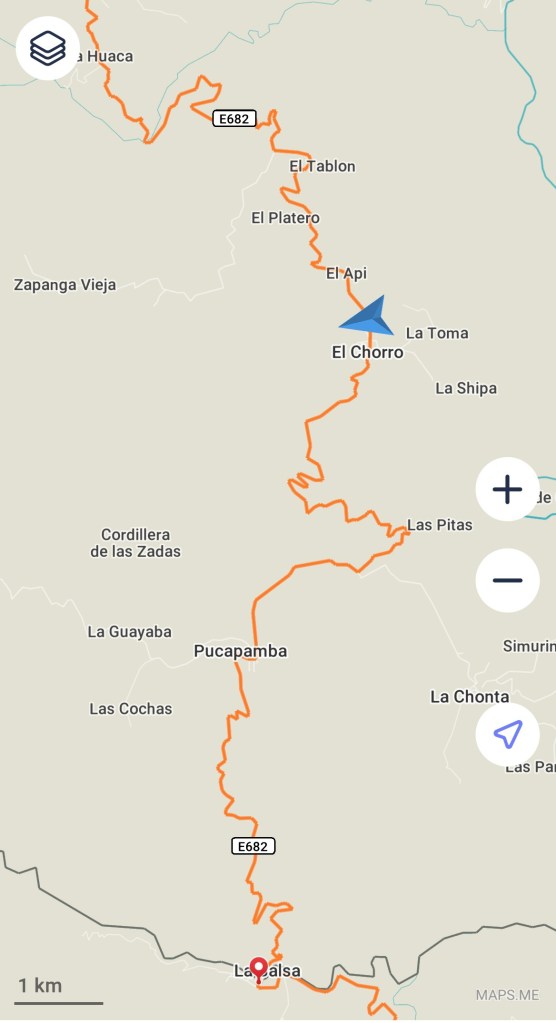
A map view of the road from Zumba to the border at La Balza. There’s not much that’s flat or straight in southern Ecuador.
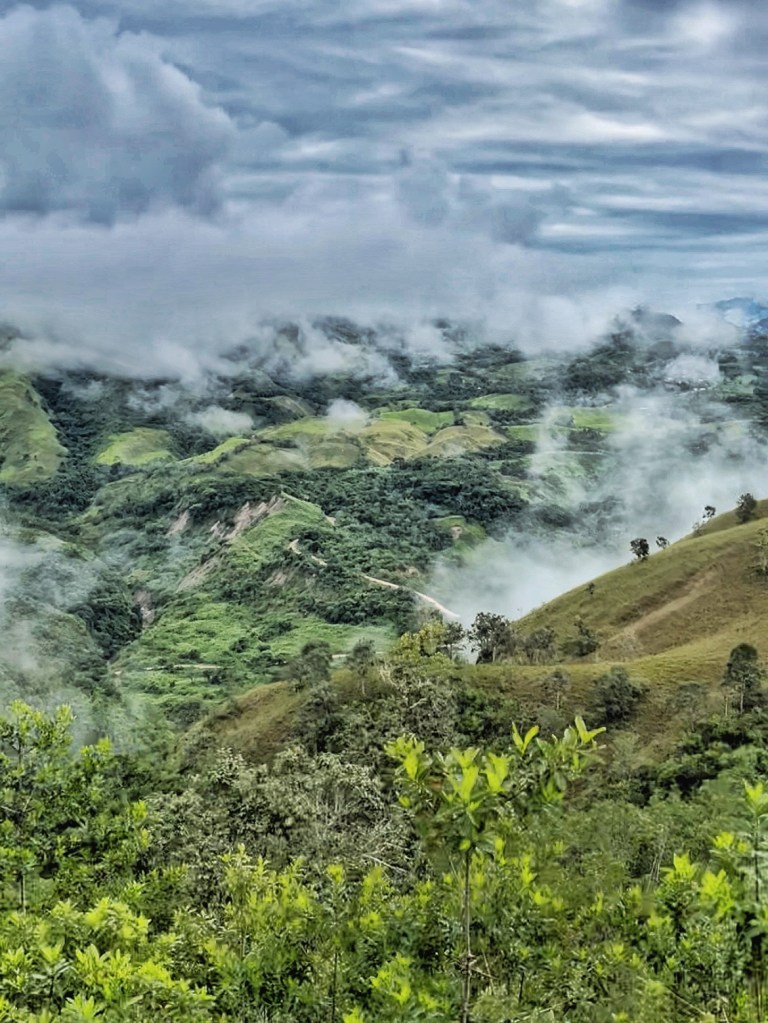
On the way to the Peru border.
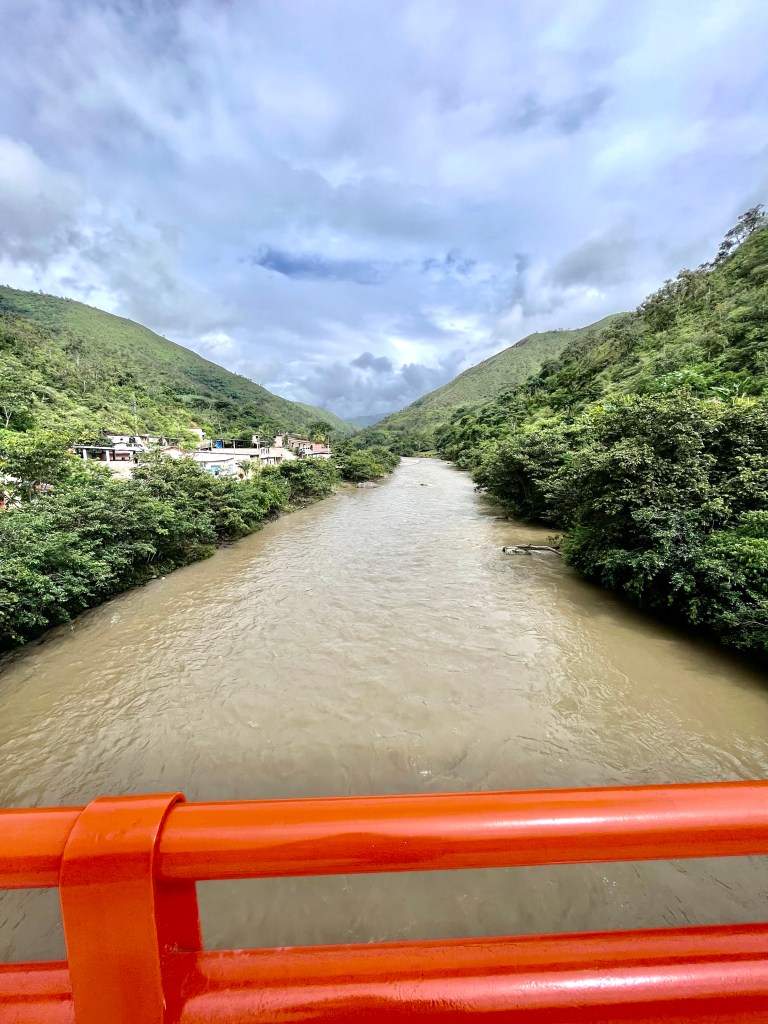
The Canchis River separating Ecuador (on the right) from Peru.
Getting Around
I traveled everywhere by bus and ranchero, and once between Loja and Villacabamba in a shared taxi. The bus transportation system in Ecuador works more or less the same way it works in Peru and Bolivia: there are large and surprisingly modern and organized central bus stations in Guayaquil and (to a lesser degree) Cuenca where you’ll find scheduled departures to anywhere in the country, but in other towns you have to start asking locals from where and when the bus to such and such a place leaves, then snoop around to find it. Buses, minibuses and shared taxis left for various destinations from different points around towns. Luckily Ecuadorians are delightfully friendly and helpful, so it was never a problem asking them for information and getting where I needed to go.
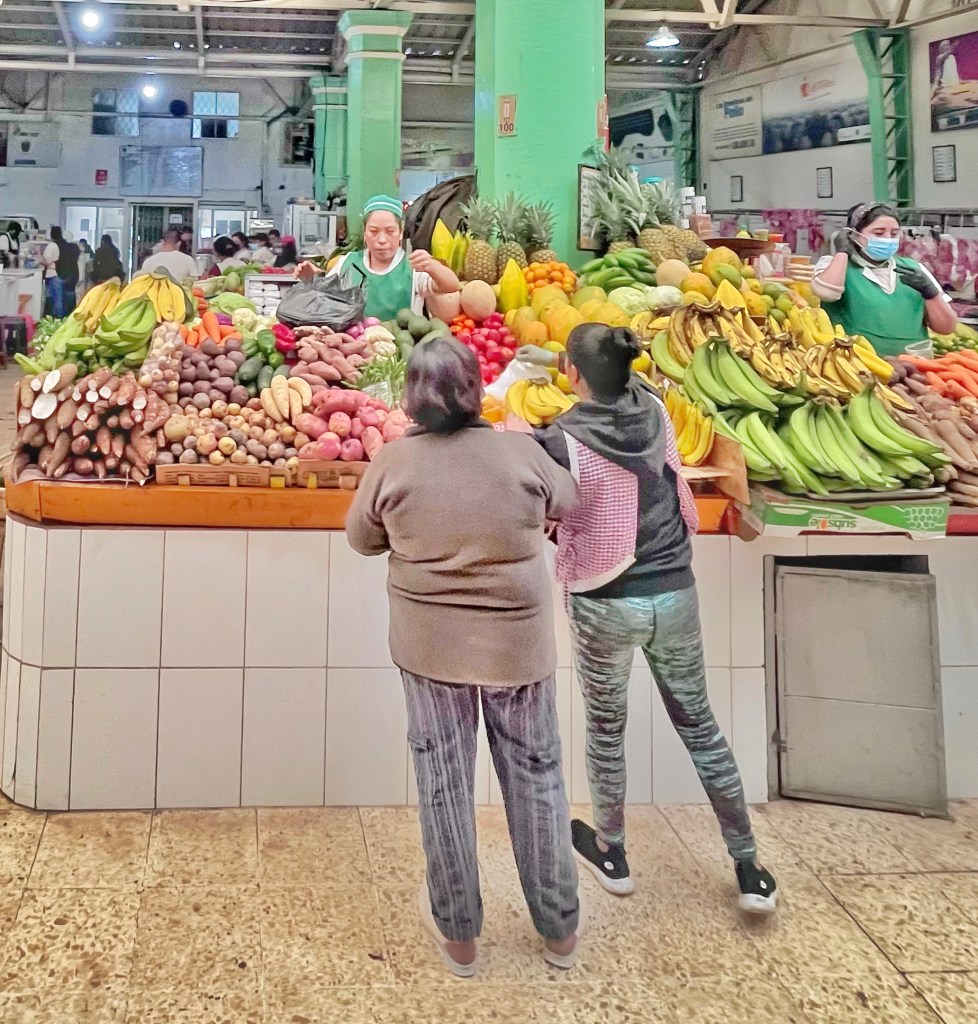
Fruit and veg shopping in the Loja market.
My Favorite Things & Places
At the top of the list would have to be the scenery. Even ugly and rough Guayaquil had a wonderful setting on the lush and exotic Guayas River, but the other places I visited are all in the mountains, and are stunning. It’s hard to believe, but I’d have to say Ecuador is at least as beautiful as Colombia, maybe even a little more here and there, and that’s really saying something because Colombia is spectacular (see my blog post on Colombia, here). Spending a morning or afternoon on a bus, scooting across valleys and over mountains was extremely satisfying (if not occasionally terrifying), and I had some wonderful country walks through verdant and colorful rural landscapes. The scenery and geography is really something.
Accommodation
Finding a place to stay in Ecuador proved to be very easy, and the quality of rooms was high for the price. My hotel in Guayaquil was comfortable but a little overpriced at close to US$30 per night, which is often the case in big cities; but I had excellent digs in Cuenca, Loja, Villacabamba and Zumba, all for between US$12-$15. As with other places on this trip I found hotel listings on Booking.com and Google, then contacted the property directly via WhatsApp to make a reservation. Hotel managers were polite and efficient, and everything was clean, if sometimes a little old or shabby.
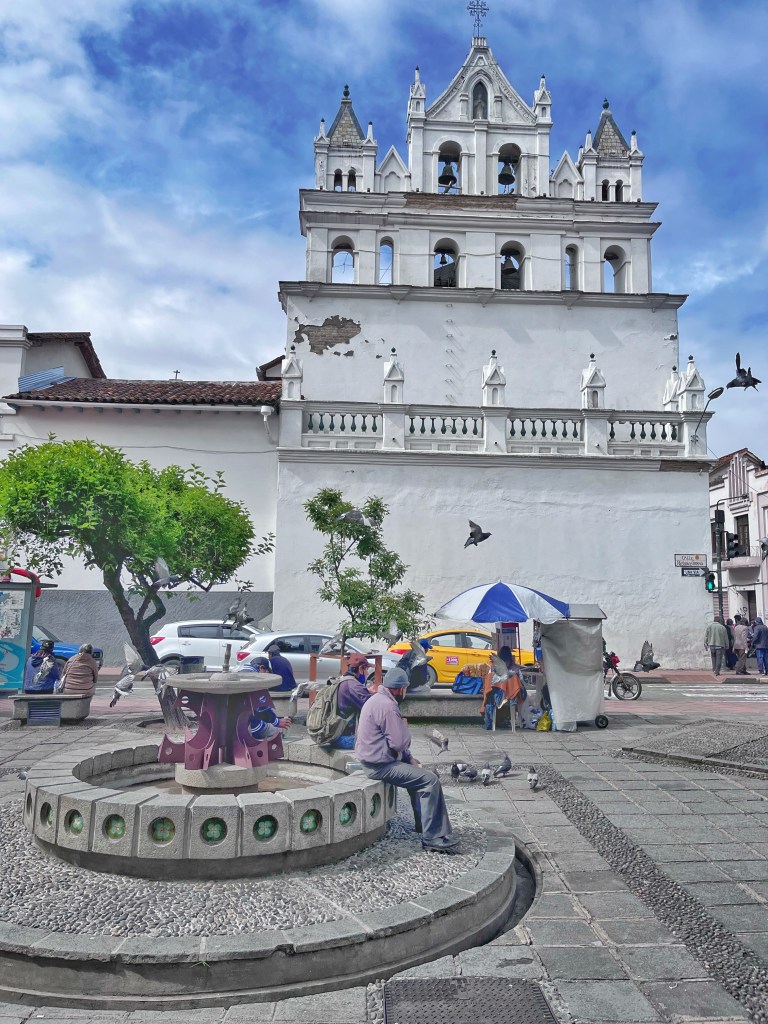
The little plaza and church just outside my hotel in Cuenca.
Food
The food is outstanding, and is a real highlight of travel in Ecuador. I’d say Peru has the edge on overall quality and variety of dishes, but Ecuador comes in a close second. Seafood favors prominently, even in the mountains. The system works more or less the same as in neighboring countries: you sit down at a table and are brought a soup, often something very hardy, closer to a stew. Then you choose between a couple of main dishes which might include fried liver, chicken in a tangy gravy, fried fish, sausage, roast chicken or fried rice. Most dishes come with some combination of potatoes, yuca (cassava), beans, rice, plantain chips, and salad. You can choose pop or a delicious fruit juice to wash it all down.
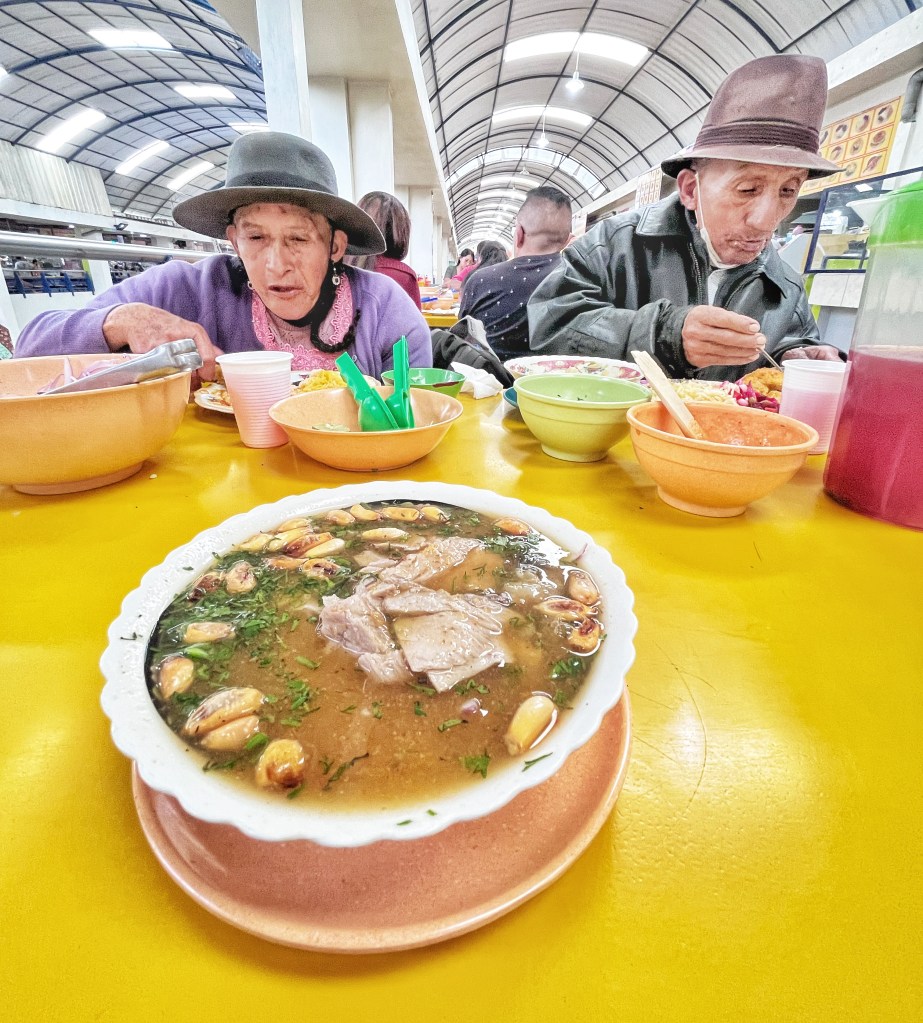
Sharing my table in the Cuenca market with a couple from the countryside while enjoying a delicious bowl of encebollado.
One dish of note is encebollado, regarded as a national dish and found everywhere. Essentially a fish stew, it’s made of fresh tuna, onions, yuca, and a bunch of spices like pepper, cumin and coriander, along with the secret ingredient, cilantro. You sometimes get half a ripe avocado with it. It’s found in every market and is available for breakfast, lunch and dinner. One day in Cuenca I ate three bowls of the stuff, one for breakfast, one for lunch, and one for dinner, each from a different market. Burp.
Fruit is wonderful and found everywhere, and is extremely cheap. The coffee is more or less passable, nowhere near as good as what you get in Colombia, but much better than the questionable brew that awaits you in Peru, Bolivia, or—gasp!—Paraguay.
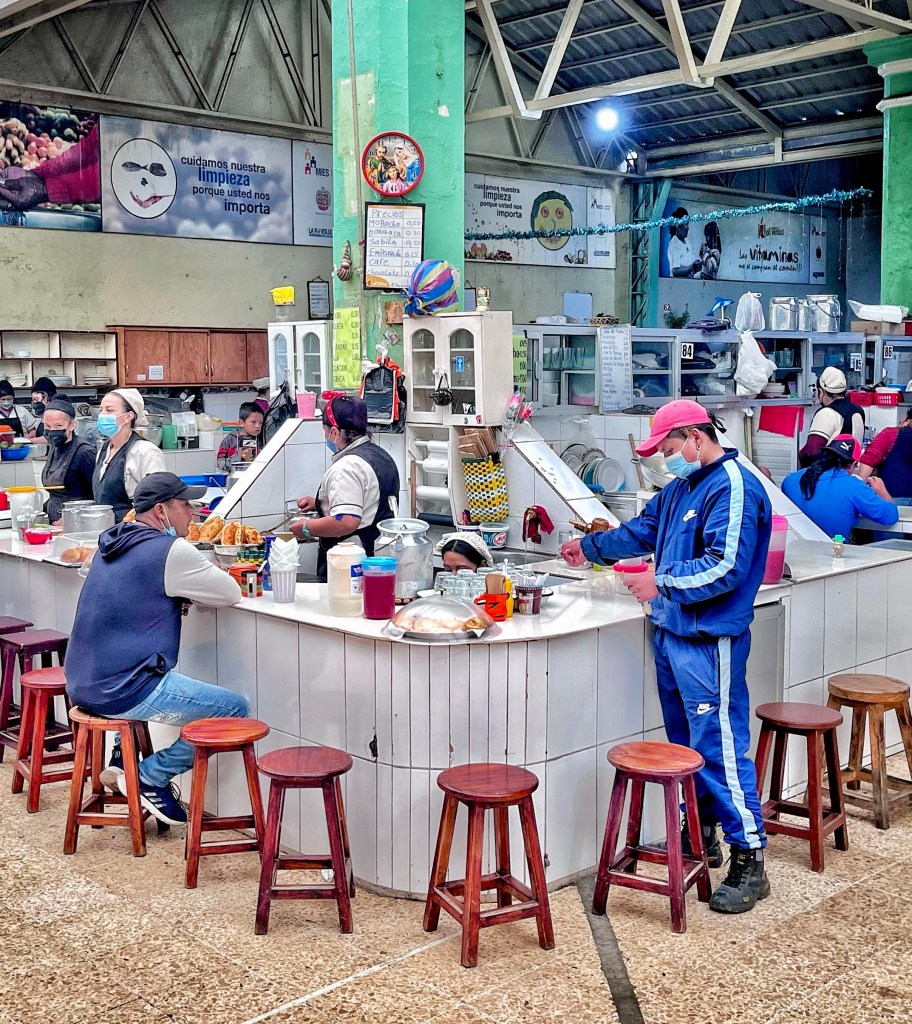
Food court in the market in Loja.
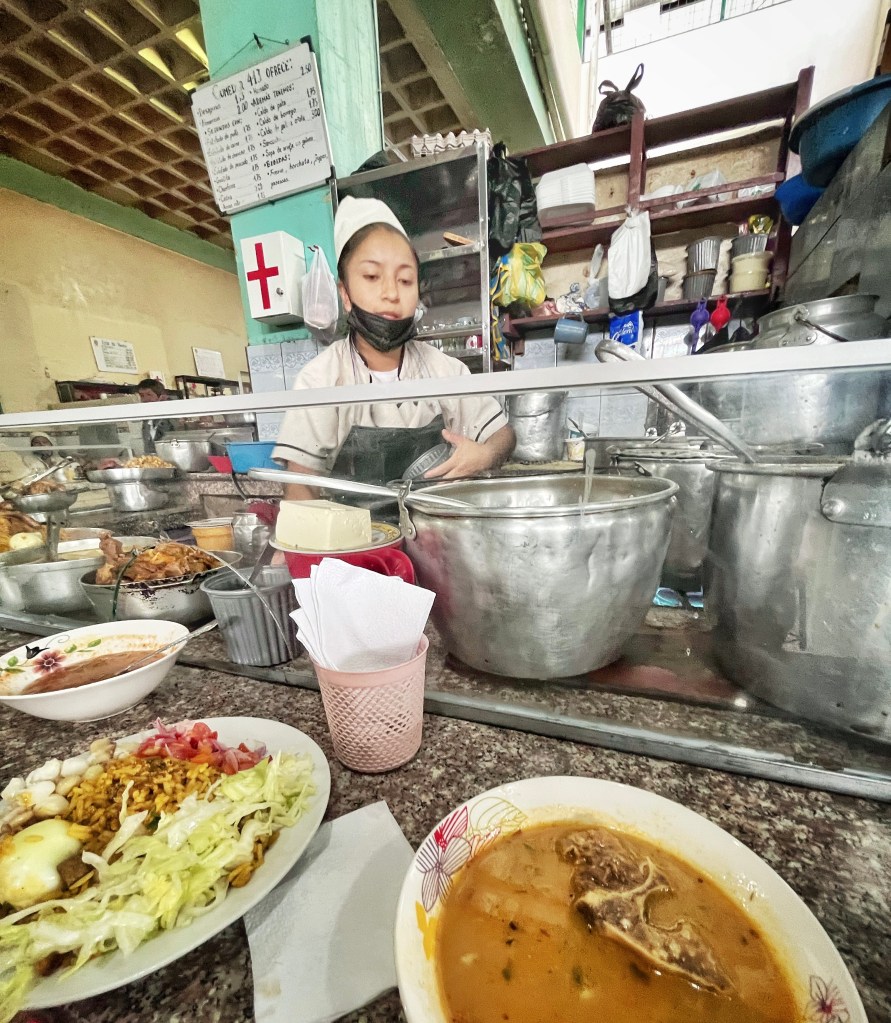
Chow time! Lunch at a food stall in the Cuenca market.
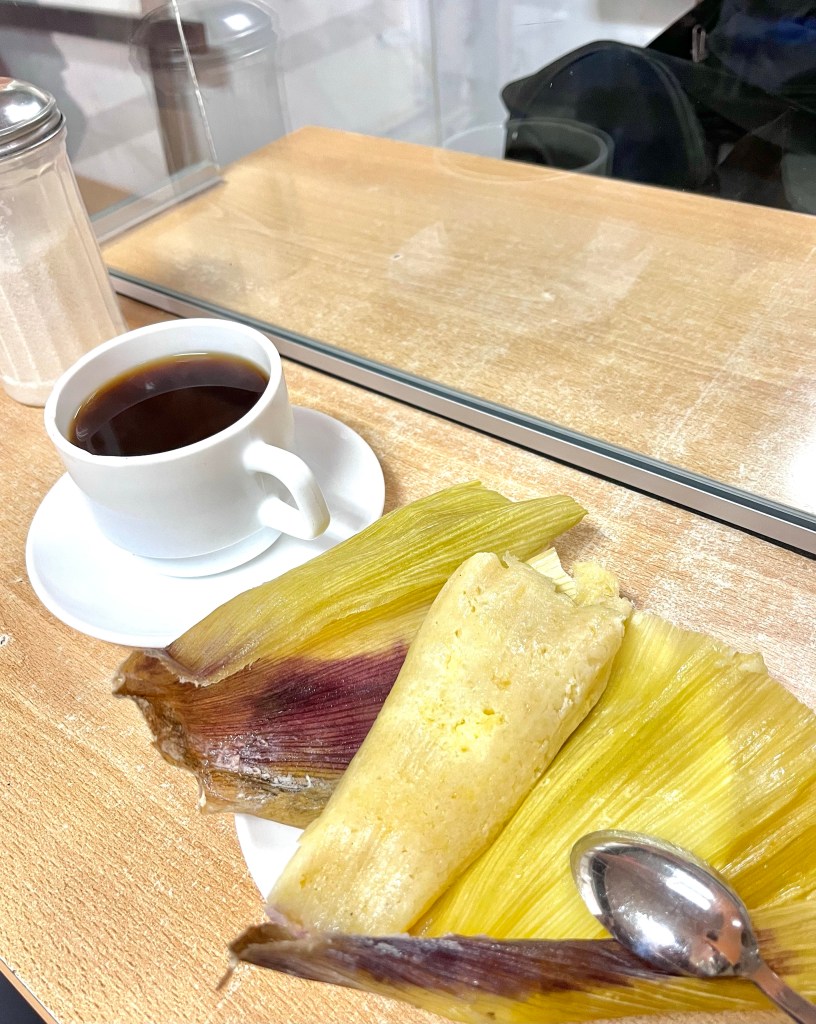
A tamale and cup of coffee for breakfast at the bus station in Guayaquil.
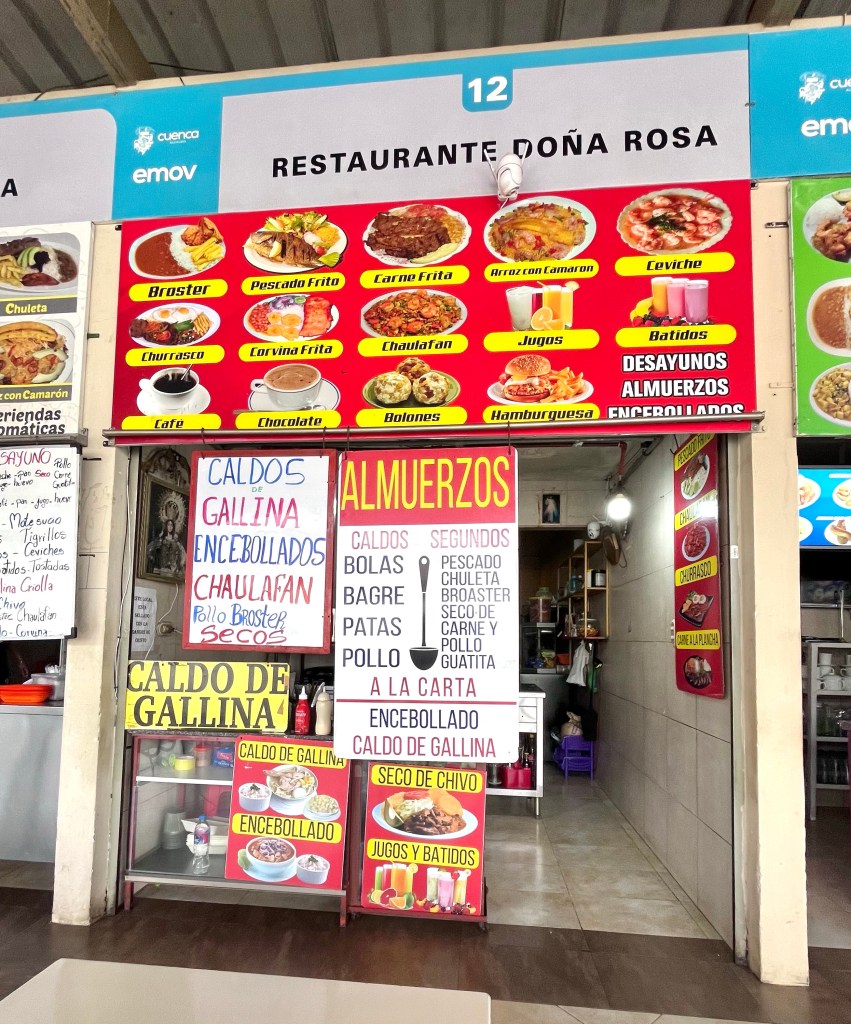
Typical simple restaurant offerings at the Restaurante Doña Rosa in the bus station in Cuenca. The food in Ecuador was very good.
People
The people are part of what makes Ecuador such a good place to travel. It’s the same thing in Colombia; the locals are unfailingly polite and pleasant in their interactions with foreign visitors (provided the foreign visitors are also polite and pleasant), but the Ecuadorians are more chatty, or at least I found it to be the case. English isn’t widely spoken, so you need some Spanish, but if you can speak then they’re happy to speak back. Ecuadorians are very patient and relaxed for the most part. I never saw much ruckus in the streets, or shouting or yelling, and people seemed to be laid back and unhurried.
There was a lot of laughing and joking in the towns, and the kids were very curious and outgoing. People in Peru and Bolivia are very friendly and courteous too, for the most part, but I found them to be more reserved and a little aloof at times; not so in Ecuador.
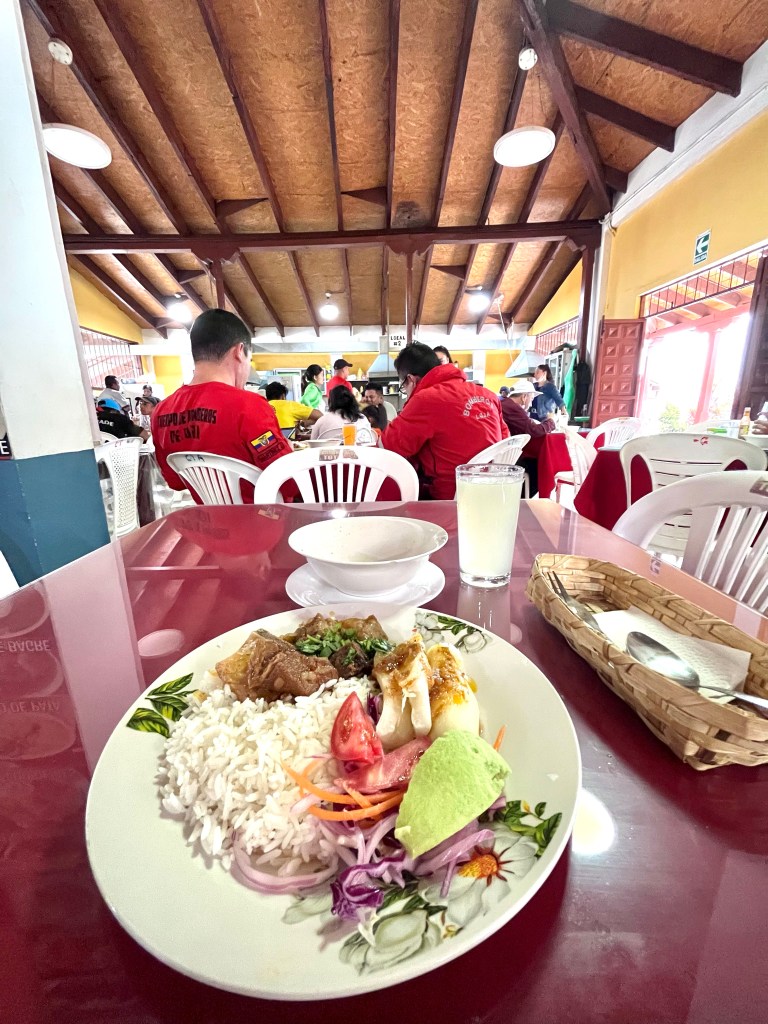
Lunch time in Villacabamba, a beef stew served with rice, yuca, salad and a glass of lemonade.
Like Bolivia and Peru, Ecuador has a large indigenous population. Twenty-five percent of Ecuador’s population is of indigenous heritage, while another 55-65 percent are Mestizos, people of mixed indigenous and European heritage. I was only in Ecuador for a short period of time and saw only a small slice of the country, but based on what I saw I’d say there were more Spanish and mestizo looking people in the towns and streets than what I noticed in Peru and Bolivia, where places seemed to be more heavily populated with people who appeared to me to be indigenous.
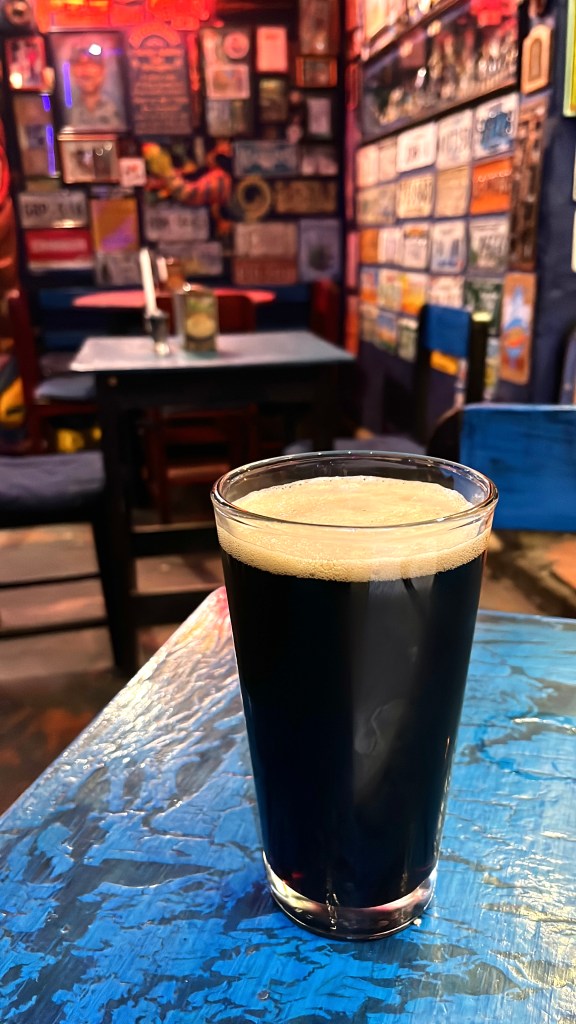
A pint of local craft beer in a funky bar in Cuenca.
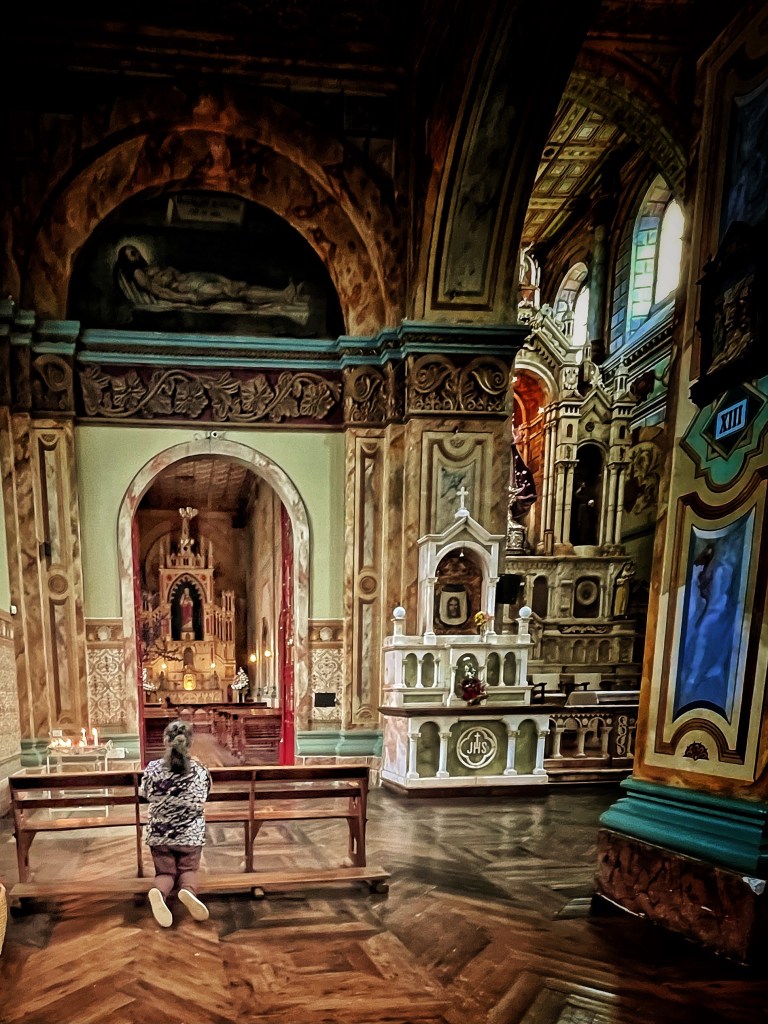
Stopping in for a quick prayer at a church in Cuenca. Most Ecuadorians are catholic.
Costs
Ecuador uses the US dollar as their official currency (the US dollar became legal tender in Ecuador in 2000 after a financial crisis that saw its own former currency, the sucre, collapse so badly that people started putting their holdings into dollars, unofficially dollarizing the country’s economy. The government simply went ahead and made the switch official), so it was slightly more expensive than Colombia, Peru or Bolivia, but costs were still very reasonable, and the country offers good value. I paid maybe a couple of dollars more a night for my rooms, and food was marginally more expensive. Still, someone who wants to travel simply and stay in modest places and eat and drink and travel with the locals can easily get by for $30-$40 per day.
For quite a few weeks after I left Ecuador and crossed into Peru I kept thinking of ways to return. Maybe after Paraguay, I thought, or if I don’t like Peru I could U-turn and head back to Ecuador. But I loved Peru, and essentially ran out of time when I was in Paraguay (I’d promised my Mom I’d be home for her birthday in late June—and I made it!), so I’ll have to visit again sometime in the future. It gives me yet another thing to look forward to. In the mean time…
Stay tuned!
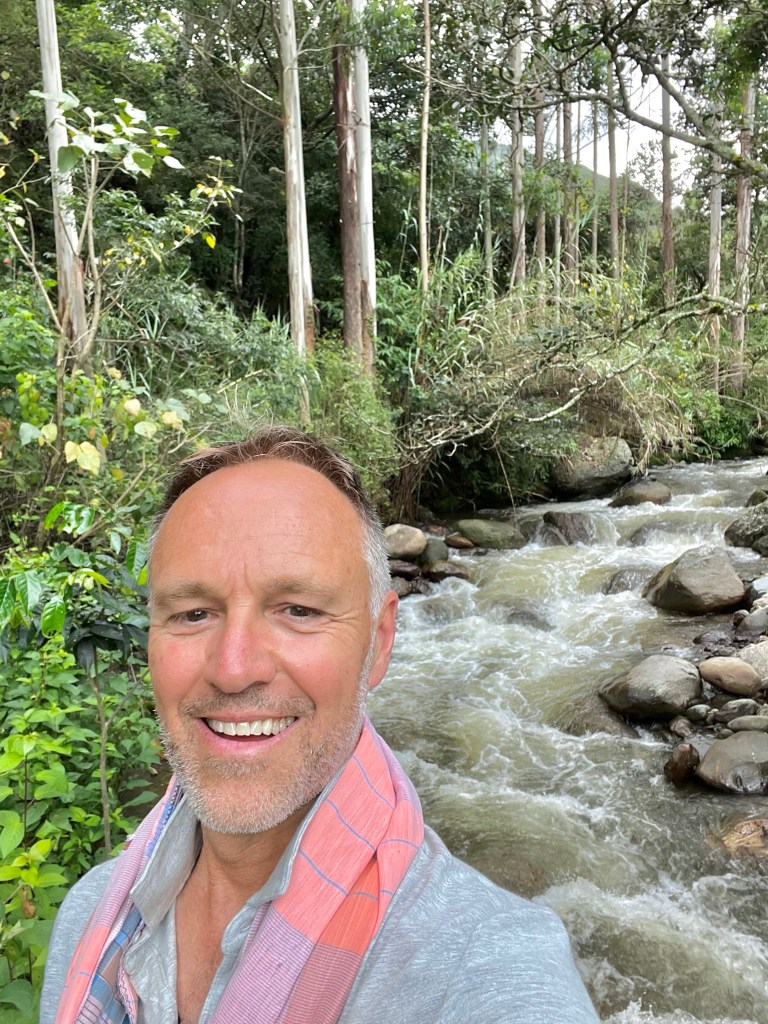
Fearless Canadian explorer braving the jungles of southern Ecuador.
* Remember! I love receiving comments, but anything you write, including when you hit “Reply” to the email notifications, is public. You know who you are…
* If you liked this story why not read some of my other blog posts? They’re all here.
* The photographs in this post, as well as many others, are all here.
* If you liked this post, why not subscribe? Sleep easy knowing you’ll never miss another story. Click on the “Follow” button, or contact me and ask to be put on the list.
Discover more from The Plain Road
Subscribe to get the latest posts sent to your email.

One thought on “Ecuador, 2022”